top of page

Another project of the Hinghwa Heritage Centre
Festivals

AI-generated illustration of Chinese Fesival.
Source: OpenAI
Festivals in Putian: A Tapestry of Faith, Folklore, and Harmony
Among the most spectacular festivals in Putian is the Spring Festival, known elsewhere as the Chinese New Year. While most regions in China observe it for 15 days, Putian celebrates it for a full month. This extended celebration is due to the daily commemoration of different deities’ birthdays, reflecting the spiritually rich and polytheistic traditions of the region.
In Southern China, there are more than 1,000 different deities, many of whom are ancient heroes elevated to divine status. This plethora of deities and their festivals reflects the unique religious identity of the people in Putian, who often do not follow the practices of other Chinese ethnic groups. The calendar is packed with observances, rituals, and processions, each day brimming with joy, color, and deep spiritual meaning.
At the heart of these celebrations is the Confucian concept of Li & Yue (礼乐), Ritual and Music. Rooted in the teachings of Confucius, Li & Yue promote a life of harmony, order, and joy through ceremonial rites and artistic expression. In Putian, this takes form in folk operas, vibrant music, rhythmic dances, and communal feasting, especially during festival times.
The customs and celebrations of Putian have deep historical roots. They were officially chronicled in the annals of Hinghwa County between 1436 and 1449 during the Ming dynasty (Zhou, 2008n). This continuity of tradition speaks volumes of the community’s commitment to preserving its spiritual and cultural identity.
Festivals Observed by the Hinghwa People
In Singapore, where many from Putian (Hinghwa) have settled, several traditional festivals are still observed. These include:
-
Spring Festival (春节)
-
Jade Emperor’s Feast Day (天公诞)
-
Spring Lantern Festival (元宵节)
-
Tomb-Sweeping Day (清明节)
-
Dumpling Festival (Dragon Boat Festival, 端午节)
-
Seventh Month Festival (中元节)
-
Mid-Autumn Festival (中秋节)
-
Winter Solstice (冬至)
While all are observed with enthusiasm, five festivals stand out for their intensity and depth of devotion among the Hinghwa people. They are:
Spring Festival: The most joyous and public, marked by community-wide celebrations.
Jade Emperor’s Birthday: The Jade Emperor, revered as the Supreme Deity in Taoist theology, is honored on his birthday, which falls on the 9th day of the first lunar month. On this day, Taoist devotees around the world hold special prayers, rituals, and offerings to express reverence and gratitude for his divine guidance and protection.
Tomb-Sweeping Day (Qing Ming Festival): A time to honor and pay respect to ancestors at their resting places.
The Dumpling Festival (Dragon Boat Festival / 端午节): This festival is to commemorate the sacrifice of honourable poet, QuYuan with dumplings that later evolve to include the dragon boat festival.
Seventh Month Festival (Zhongyuan Festival): A time for honoring ancestors and appeasing wandering spirits through prayers, offerings, and traditional opera.
Winter Solstice (Dongzhi): A more intimate occasion, celebrated quietly within the family.
These festivals are more than mere holidays; they are sacred rituals that embody acts of filial piety and serve as reminders of the importance of family unity.
Within the broader society, they foster communal bonds and reflect a rich tapestry of faith, culture, and heritage passed down through generations.
*

Spring Festival (Chinese New Year)
(春節)
Source: Wix
The Spring Festival is the most auspicious occasion for all Chinese communities.
Preparation for the Spring Festival begins a full month in advance, starting from the first day of the twelfth lunar month. Among the Hinghwa people, this period is known as Zo Ue (做岁; Zuò suì), meaning “preparing for the New Year.” The culmination of these preparations takes place on the last day of the twelfth lunar month, known as New Year’s Eve (三十暝), or more intimately in Hinghwa as Xiǎo Nián Mîng (小年暝) — the ‘Little New Year’s Night.’
On New Year’s Eve, families lay out an elaborate feast in honour of the God of Heaven (天公; Tiān Gōng), their household deities, and their ancestors. One particularly symbolic offering is a bowl of rice with a FuLuShou paper flower (福禄寿纸花; fú lù shòu zhǐ huā) inserted into it. FuLuShou refers to three deities representing blessing (福), wealth (禄), and longevity (寿).
This bowl, known in Hinghwa as ‘Ga Ning Bue’ (隔年饭), meaning "rice across the year," remains on the altar until the New Year officially arrives. It symbolizes the hope for abundance and continuity, from one year into the next (Lin, 2013a).
*
‘Tan Morng’ (探亡) -- Commemoration amidst Celebration
When the Japanese were eventually driven out by General Qi Jiguang (戚继光) and his troops, the people returned to scenes of devastation. The bodies of loved ones who hadn’t escaped still lay unburied. There was no joy, no feasting, only grief.
What should have been the first day of the Lunar New Year instead became a day of mourning. The Hinghwa called this day ‘Tan Morng’, meaning “visiting the dead.”
-
On the second day, survivors visited relatives and friends to check who was still alive and to account for the dead.
-
On the third day, Lin Zhaoen (also known as Lin Long Jiang 林龙江), a revered local scholar and later deified figure, led efforts to bury the deceased and begin the healing process.
-
It was only on the fourth day that the people could finally begin preparations for their New Year.
Thus, for the Hinghwa, the fourth day became their "Eve" of Chinese New Year, and the fifth day became the true beginning of the celebration, a quiet but resilient act of remembering and honouring the lives lost.
While other Chinese communities may begin their celebrations on the first day of the Lunar calendar, the Hinghwa people's observance, rooted in collective memory and reverence for the past, begins on the fifth. Other ethnic groups in Southern China who also suffered similar atrocities may have their unique commemorations on different dates.
*

AI-generated illustration of Chinese reunion dinner.
Source: OpenAI
Chinese New Year Reunion Dinner is a night that every member of a Chinese family cherishes. It is so important that in China, the need to reunite with parents, families, and loved ones sets in motion the world's biggest migration across the country that spans nearly 10 million square kilometers.
This is a time when loved ones gather around a round table, a symbol of unity, to savour the dishes lovingly prepared, often by the Matriarch of the family.
Following the reunion dinner, it's time for the beloved tradition of red packet giving (红包). Parents gift their children with these envelopes of ‘lucky money’, called ‘Da Ui Ling’ (哲岁钱) in Hinghwa, symbolising a wish for their children to grow in wisdom and grace. In return, married children also give smaller red packets to their parents and younger siblings, often including a more generous gift for their parents as a token of gratitude for their love and care.
Then comes the lighting of the family lanterns, a beautiful ritual meant to keep the home bright throughout the night.
In Hinghwa, this is known as ‘Dieng Tao Ma Ue’ (晚上灯火彻夜通明; Wǎnshàng dēnghuǒ chèyè tōngmíng), a poetic expression of hope, light, and continuity.
After the excitement of the evening, the family enters a reflective phase known as Shǒusuì (守岁), or ‘Ziu Ue’ in Hinghwa. This is the act of staying awake to "guard the year", akin to countdown to midnight to welcome the new year.
When the clock strikes midnight, the moment is called ‘Kui Zia’ (开正; Kāi zhèng), marking the official dawn of the Lunar New Year. Joy, reverence, and renewal fill the air.
However, the actual celebration of the Chinese New Year by the Hinghwa people falls on the fourth day of the Lunar New Year. In Hinghwa, this celebration is known as Zo Duo Hui (做大岁), which means celebrating the “Big New Year.” This different rhythm of celebration commemorates those who perished and the resilience of those who survived during the invasion of Putian and southern China by Japanese pirates, when countless lives were lost.
The specific forms of celebration vary greatly from region to region. According to the Shiji, or Records of the Historian, written in the first century BC, the ceremony for worshipping Heaven on the fifteenth day of the first lunar month could continue through the night (Qi, X., 2010b, pp. 29–30).
*
In the 1960s and early 1970s in Singapore, the Hinghwa lion dance and dragon dance troupes would typically perform on the 15th day of the Chinese New Year, primarily for members of the Hinghwa clan.
As the lion danced, troupe members would create dramatic bursts of fire in front of it by throwing flammable powder or blowing mouthfuls of kerosene onto fire torches they carried. These torches resembled those once used by ancient Chinese villagers to light their way at night.
The Hinghwa lion dance was widely regarded as the best in Singapore at that time -- not only was the lion costume beautifully crafted, but the troupe itself was highly skilled and well-versed in traditional Chinese martial arts. Following the lion dance performance, puppeteer troupes would visit Hinghwa households to pay respects to each family's deity.
In return, each troupe typically received a red packet containing a token sum of money for their visit.
In Singapore, the celebrations usually end in a Chingay Procession -- a grand convoy of elaborately decorated lorries adorned with glittering lights. The procession, along with the participating troupes, closely resembles the traditional She Huo, though without firecrackers due to the nationwide ban.
*
A Different Rhythm of Celebration


The Hinghwa people, especially those with roots in Putian, the New Year is observed quite differently -- a difference rooted in tragedy.
*
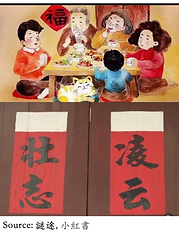
Some people may have noticed red banners with white couplets pasted on the doors of certain homes. These are not only symbols of Chinese New Year celebrations but also commemorate a historical event from the Ming dynasty that left a lasting cultural impact. As a result, the Spring Festival in this region is observed not just as a joyous celebration of the new year, but also a time to commemorate those who perished, and those who suffered during that tragic period. This gives the festival a unique tone of remembrance alongside its festive spirit.
*

During the Ming dynasty, on 29th November 1562 (Lunar Calendar), Putian and large parts of Southern China were ravaged by an invasion of Japanese pirates known as ‘Wokou’ (倭寇).
These invaders swept through towns, killing, raping, and plundering. Many locals fled for their lives, hiding in sugarcane plantations (Xu, 2012b).
Historical records paint a grim picture:
“More than 6,000 elite Japanese invaders captured Hinghwa mansion and burned houses in the city. A total of 898 families were destroyed, and 22,961 people were killed, including 19 Jinshi and 356 Xiangsheng (庠生)” (Chen & Liu, 2019).
This event marked the second massacre of Putian, and it left an indelible scar on the community.
*
AI-generated illustration of Japanese pirates attacking Putian
Source: OpenAI

Source: Author
The sugar cane plant became a symbol that saved the lives of many, where the dense plantation made it a perfect hideout.
Hence, the plant became part of the preparation for the Spring Festival; many Southern Chinese, including those from Putian, will place a pair of sugar cane plants, complete with roots on both sides of their doorway.
This act recalls the moment when villagers, fleeing the Wokou invaders, found refuge in the sugar cane plantations. These tall, leafy plants became shields of survival, hiding families from unspeakable horrors.
Over time, the symbols of sugar cane have grown richer. Today, they also represent the wish that children will grow tall and strong, progressing step by step in life, "步步高升" (bù bù gāo shēng), which means rising higher with every step.
These rituals, the white headbands, the red-white couplets, the sugar cane at the door, weave together a powerful story of a people who do not forget. They mourn. They heal. And they celebrate with reverence, carrying the spirit of their ancestors into each new year.
*
The Japanese pirates were unstoppable, and they ruled the Nanyang, all the way to the Philippines. It was not until General Qi Jiguang (戚继光) led an army, together with the people and the Xianyou army, that they began to resist the bandits when the latter attempted to invade Xianyou County.
To trap the bandits, they built a 2 km wall with a watchtower that also acted as a trap for the invaders. Many local heroes, such as Lin Zhaoen, also known as Lin Longjiang (林龙江), strongly aided him.
*

Source: Author & Lin Zhou
The initial construction of the 2 km wall was meant to keep out the Japanese invaders during the Ming dynasty. The wall was later extended to 37 km during the Qing dynasty to keep out an opposing army led by Zheng Chenggong (郑成功).
*
‘Tan Morng’ (探亡), Mourning Instead of CelebratingWhen the Japanese were eventually driven out by General Qi Jiguang (戚继光) and his troops, the people returned to scenes of devastation.
The bodies of loved ones who hadn’t escaped still lay unburied. There was no joy, no feasting, only grief.What should have been the first day of the Lunar New Year instead became a day of mourning. The Hinghwa called this day ‘Tan Morng’, meaning “visiting the dead.”On the second day, survivors visited relatives and friends to check who was still alive and to account for the dead.
On the third day, Lin Zhaoen (also known as Lin Long Jiang 林龙江), a revered local scholar and later deified figure, led efforts to bury the deceased and begin the healing process.It was only on the fourth day that the people could finally begin preparations for their New Year.
Thus, for the Hinghwa, the fourth day became their "Eve" of Chinese New Year, and the fifth day became the true beginning of the celebration, a quiet but resilient act of remembering and honouring the lives lost.
While other Chinese communities may begin their celebrations on the first day of the Lunar calendar, the Hinghwa people's observance, rooted in collective memory and reverence for the past, begins on the fifth. Other ethnic groups in Southern China who also suffered similar atrocities may have their own unique commemorations on different dates.
The longing for longevity is best expressed in their favourite noodles that became known as the Longevity Noodle.

General Qi Jiguang and the Jiewai Wall in Putian
Source: Author & Lin Zhou
Sou Min (线面) aka
Shou Mian (寿面) aka
Mazu Mian (妈祖面线),

Source: Author
On the first day of the Lunar New Year, the married couple traditionally visit the husband’s parents first, followed by the wife’s family in the afternoon.
The family usually enjoys a special meal of longevity noodles, known in Hinghwa as ‘Sia Sou Min’ (吃线面). Because of its significant meaning -- rope noodle (线面) became Shou Mian (寿面) or longevity noodle. It later became Mazu Mian (妈祖面线). Mazu is worshipped by Southern Chinese as the Queen of Heaven.
These long noodles symbolize a heartfelt wish for health and long life. Each ingredient in the dish carries symbolic weight, and there's even an order in which ingredients are eaten first, signifying respect and intentionality.
In Putian, the first day of the New Year is also marked by a custom known as ‘Iu Cong’ (游春; Yóu chūn), or “Spring Outing.” Families venture out to enjoy the fresh air, visit temples, or explore places of interest -- ushering in the new year with cheer, beauty, and spiritual renewal.
*
Celebrating the Jade Emperor's Birthday.
In Putian, there are about 80 temples dedicated to the Jade Emperor, many of which are located in the most scenic spots in the region. Celebrations are held on the 9th day of the first month of the Lunar Calendar, and again on the 16th day of the fifth lunar month.
*

Sand FlowerSource: Cai, J. C., 2012.
On these special occasions, the people create sand flowers to welcome the Jade Emperor, a tradition known locally as 砂花迎神 (shā huā yíng shén). The custom dates back to the Ming dynasty. The Hinghwa refer to it as Pa Sa Ua (拍銼花; Pāi cuò huā).
This unique spectacle involves scattering molten cast iron onto trees -- such as longan and lychee trees, to produce flower-like bursts of light.
Though primitive, it resembles a type of fireworks and is no less spectacular. The purpose of this tradition is to welcome the Jade Emperor, bring joy to the community, and eliminate insects harmful to fruit trees (Cai, 2012b).
Such practices are not observed in the Nanyang region.
*
The celebration of the Jade Emperor's birthday is considered the most important on the Taoist calendar. The belief in the Jade Emperor evolved from ancient Taoist theories of a supreme being. Like other Taoist deities, this belief eventually took physical form in the shape of an idol.
Apart from temple-based rituals, other festivities are celebrated more publicly, including numerous cultural festivals.
The 15th day of the first lunar month marks the end of the Chinese New Year celebrations.
*

Sources: Douyin
Arrangements by Author
Source: Wix
The fifteenth day of the first month of the Lunar Calendar is the last day of the Chinese New Year celebration. The Hinghwa call this day Sek Ngo Mah.
On this day, streets come alive with firecrackers and vibrant performances, including lion dances (舞狮), dragon dances (舞龙), all moving energetically to the beat of drums and gongs.
These parades often include stilt walkers (行柴骰; 珠高晓), big-headed dolls (大头; dàtóu), kung fu displays (功夫展示), and more.
The grand finale ends with the lantern festival.
*

Tomb Sweeping Day

Source: Ethan Ong
This is a traditional Chinese tomb that belongs to a notable family in Singapore.
Tomb sweeping day is known in Chinese as 掃墓節. It is also called Qing Ming Festival (清明節). It is an occasion when the family gathers to wash and clean the tomb, clearing away overgrown plants and debris.
Depending on their faith, family members may observe different practices: Christians may offer prayers, while Taoists might perform rituals that include offerings of food, drinks, and incense.
This practice reflects a long-standing tradition of remembering and honoring departed loved ones, a core value that has been passed down since the earliest days of Chinese civilization.
*

Dumpling Festival
(Dragon Boat Festival) (端午节)
The Dumpling Festival, also known as the Dragon Boat Festival, is traditionally held on the 5th day of the 5th lunar month to commemorate the death of the ancient Chinese poet and statesman Qu Yuan. During the chaotic Warring States period (c. 475–221 BC), Qu Yuan drowned himself in the Miluo River as a protest against political corruption and the fall of his beloved state, Chu.
To honor his memory and to prevent fish and other river creatures from consuming his body, local people made zongzi (sticky rice dumplings wrapped in bamboo leaves) and threw them into the river as offerings.
While the story of Qu Yuan is the most widely known legend behind the festival, the dragon boat races themselves are not merely a later addition for spectacle. In fact, dragon boat traditions are much older than the Qu Yuan story, with roots in ancient agricultural rituals, dragon worship, and riverine military exercises. Over time, the act of racing boats and throwing zongzi became intertwined with the commemoration of Qu Yuan, creating the rich, multi-layered festival we know today.
Seventh Month Festival
(中原节)

Honoring the Spirits with
Ritual, Reverence, and Harmony
AI-generated illustration on Chinese prayer offerings.
Source: OpenAI 2025
The offerings made at the home altar are usually private affairs, with the focus placed on honoring ancestors. In the past, some families might have hosted traditional opera or puppet shows, but these practices are rarely seen today due to their high cost. Instead, such performances are typically organized by temples or community leaders, who collect monthly contributions from members. The size of the membership often determines the scale of the celebration: larger communities can afford more elaborate rituals, featuring giant joss sticks, giant size pig carcasses, huge amount of canned food, fruits, and drinks, chanting by Taoist priests, and even parades of spirit mediums piercing their mouths, tongues, or bodies with skewers.
Public offerings are generally conducted in an orderly manner, except when priests scatter coins, often in one-cent denominations. In the early 1960s, when many families were struggling financially, every cent picked up was considered a blessing.
Although such practices are no longer common in Singapore today, they are still observed in parts of Asia. In some places, food offered to wandering spirits during the festival is quickly snatched up by passers-by after prayers are completed. However, as shown in the videos, it is not always the case.
(These are third party videos. Please watch it at your discretion)
Video One
Video Two
Video Three (Watch your back :))
The Evolution of the Zhongyuan Festival (中元节)
The present-day Ghost Month Festival evolved from a single-day observance in China into a month-long tradition, shaped by the interweaving of Taoist and Buddhist beliefs.
Archaeological findings in China suggest that forms of worship, particularly ancestor veneration, existed from early times. This system of honoring ancestors and connecting with the spirit world became more structured when Taoism developed into an organized theology under the guidance of its founder, Zhang Daoling.
With the establishment of the lunar calendar, a specific day for ancestor worship was fixed: the 15th day of the seventh lunar month, known as Zhongyuan Festival (中元节). On the Gregorian calendar, the last day of the 7th Lunar month in 2025 falls on September 20th. This day coincided with the transition from summer to autumn, around the time of the Autumnal Equinox (秋分). Traditionally, this was when people harvested their crops before the onset of winter, a season when farming ceased. It was also considered the most appropriate time to make offerings to ancestors, as food was plentiful.
Buddhism, introduced to China during the Han dynasty, soon influenced Chinese beliefs with its theology and stories. One of the most enduring tales was that of Mulian (Maudgalyayana), a devoted disciple of the Buddha. According to legend, Mulian discovered through his spiritual powers that his deceased mother was suffering in the spirit realm, plagued by unending hunger and thirst. Each time he tried to offer her food, it turned to burning coals before she could eat. Heartbroken, he sought guidance from the Buddha, who instructed him to make offerings on the 15th day of the seventh lunar month, not just for his mother but also for the community of monks. By doing so, Mulian accumulated great merit, which freed his mother from torment and brought blessings to his family.
This story deeply resonated with the Chinese, as it reflected the virtue of filial piety, the cornerstone of Confucian values. During the Tang dynasty, when Buddhist influence reached its height, the festival was widely embraced. Over time, however, its scope expanded. Ancestor worship gradually extended to include wandering spirits, souls without living descendants to honor them. What began as an act of filial devotion evolved into a collective ritual to feed and appease all spirits, ensuring peace and protection for the living.
Thus, the single-day observance of Zhongyuan Festival transformed into the month-long Ghost Month Festival, a time when the boundary between the human and spirit worlds is believed to be most open. It became not only a celebration of family ties and filial piety but also an act of compassion for forgotten souls.
In this month, Taoist temples and mediums in deep trance come alive with activity. Altars are filled with offerings, elaborate rituals are conducted, and the streets echo with folk operas, percussion music, and ceremonial chants. These communal practices aim to appease the spirits and ensure peace between the living and the dead.
The origins of this festival are closely intertwined with Confucian teachings, particularly the LiJi (礼记) or "Book of Rites". As Peng (2011) aptly describes, LiJi is for harmony and peace. That was the value of Li (礼). Without it, we would still be savages. The rituals and etiquette defined in LiJi emphasize respect, reciprocity, and moral conduct, which extend beyond our interactions with the living to include those who have passed on.
This philosophy gave rise to practices such as tomb sweeping and the Seventh Month Festival, both of which reflect a deep cultural belief: that honoring the dead is a continuation of showing respect, a cornerstone of civil society. By observing these rites, the community not only shows filial piety and reverence but also reinforces the Confucian ideal of Li (礼), ritual propriety, as a means to maintain peace and harmony in the cosmos.
---
The Chinese term 中元节 (Zhōngyuán Festival) takes its name from one of the three major festivals in the Taoist calendar.
The first of these is 上元节 (Shàngyuán Festival), celebrated on the 15th day of the first lunar month. It honors 天官 (Tiānguān), the Official of Heaven, a deity believed to bestow blessings and good fortune. Appropriately, this festival coincides with the start of the Lunar New Year, embodying hopes for prosperity and a bright beginning.
The second is 中元节 (Zhōngyuán Festival), observed on the 15th day of the seventh lunar month. It honors 地官 (Dìguān), the Official of Earth, a deity believed to forgive sins. This observance overlaps with the “Ghost Month,” a period dedicated to ancestor worship and rituals for wandering spirits. A month later comes the 中秋节 (Zhōngqiū Festival), or Mid-Autumn Festival, which will fall on 6 October 2025 in the Gregorian calendar, corresponding to the 15th day of the eighth lunar month.
The third is 下元节 (Xiàyuán Festival), held on the 15th day of the tenth lunar month. It honors the Water Official, a deity believed to avert disasters and misfortune, particularly floods, typhoons, and other natural calamities that historically threatened crops and livelihoods as winter drew near.
A recent video capturing hailstones in Beijing on 14 September 2025 serves as a vivid reminder of how quickly the weather can shift from one season to another. It also signals the turning point when agricultural work slows and the land gradually yields to the coming of winter.
Together, these three festivals embody the Taoist vision of harmony between Heaven, Earth, and Water, with each deity safeguarding human life in a unique way.
---
Storm havoc in East Asia in September 2025.
North China (Beijing)
South East China (Taiwan) (Near Putian)
Southern China (Guangdong Province)
*
The highlight of the Seventh Month Festival is the lively entertainment featuring food and music. This is when traditional opera and puppet show come to life.
*
Hinghwa Opera in Putian
Source: Author & Lin Zhou
Puppet show in Jiulidong, Jiangkou, Putian
Source: Author & Lin Zhou
Winter Solstice Festival (冬至)
(A Quiet Celebration of Hope)
In Hinghwa, the dish is known as 'dang nei'.

Source: Lee Lay Eng
The Winter Solstice Festival, or Dongzhi (冬至), typically falls on 21st or 22nd December each year. Unlike the exuberant festivals filled with music and dance, Dongzhi is a quiet, intimate celebration, usually observed within the home and amongst family members.
In China, this festival marks the coldest period of the year. Historically, it was a time when the weakest in society, the elderly, the sick, and the very young, were most at risk. During this season, farm work slowed to a halt, and food supplies became limited. Before modern infrastructure and healthcare, life for nearly 90% of China's population, mostly farmers, was especially precarious. Thus, Dongzhi was more than a seasonal marker; it was a symbol of survival and resilience, a time to gather as a family, to share warmth, and to hope for better days ahead.
Central to the celebration is the sharing of special dishes, often dumplings or tangyuan (glutinous rice balls), which are symbols of unity and completeness. These foods carry a silent but powerful message: the family remains whole, despite the harsh environment outside.
Even in Nanyang (Southeast Asia), where the cold does not reach, the spirit of Dongzhi remains deeply cherished. For migrant communities, especially, it becomes a touchstone of cultural identity and familial bonding. As the Lunar New Year approaches, Dongzhi serves as a gentle reminder of the importance of togetherness, anchoring the family in tradition and preparing hearts for the celebrations to come.
*
The Chinese have always held the belief that tomorrow will be better, and so it will be.
Rooted in the wisdom of the I-Ching, change is seen as inevitable. Just as the harshest season eventually gives way to spring, difficult times will also pass. The dawn of better days calls for preparation, as people ready themselves to welcome a new season with hope that the coming year will surpass the last.
Offerings, therefore, serve a dual purpose: to give thanks for the blessings of the year that is ending, and to invite good fortune and renewal for the year ahead.
Thus, the preparations for a new year mark not just an ending, but the beginning of yet another cycle of life and hope.
Gentle Reminder. This is a third party video. Please watch at your discretion.
bottom of page