
Another project of the Hinghwa Heritage Centre

Singapore

Singapore Financial District
Source: Author with AI-Generated Illustration of Hinghwa Heritage Centre
Singapore: The First Port of Call
Singapore was the first port of call for many migrants. It was often said that while most arrived friendless and penniless, they were never mindless. They carried with them a rich cultural heritage and a resilient spirit, qualities that helped transform the Nanyang region into a golden age of opportunity and growth.
As Rajah James Brooke, the British ruler of Sarawak, once remarked:
“Without the Chinaman, nothing can be done.”
This sentiment was echoed by Datuk Philip Lau King Kah, former president of the Hin Hua Pou Sen Association in Sibu, who poignantly observed:
“从传统走向现代,由苦难走向光明,虽然是一条充满悲歌和崎岖的道路,但是,勤劳,刻苦和节位的生活美德和勇于冒险的开拓精神,却造就了兴化人无数的荣耀和功名.” (Wong, 2012c, p. 1)
The journey to modernity for the Hinghwa people was paved with suffering and hardship. Yet through perseverance, hard work, and an indomitable pioneering spirit, our ancestors earned countless honors and achievements.
Each country in Nanyang has its own unique migrant story. For many, Singapore was the gateway to Southeast Asia. Alongside Hong Kong, it served as a vital link connecting the British colonies across the region.
At the time, entry into Singapore only required a vaccination certificate issued by the then Kuomintang government, which had replaced the Qing Dynasty in 1912. This was critical due to a deadly virus outbreak in China, which had caused widespread, mysterious deaths.
Upon arrival, migrants disembarked on a forested island ominously named Pulau Belakang Mati, ironically translated as the “Rear Island of Death.” The origin of this unsettling name became clear when human remains were discovered buried along the beach facing the Indonesian Archipelago. Authorities suspected these were victims of human smugglers, lured to Singapore only to be killed for their valuables.
Aside from a few British military installations, the island was largely covered in dense forest and shrouded in darkness at night. In time, however, it underwent a dramatic transformation and is today known as Sentosa, a world-renowned resort destination where seafront properties can command prices upwards of S$10 million.
Upon disembarkation, all new arrivals were subjected to fumigation and quarantine, regardless of whether they held valid health certificates. Once cleared, they were ferried to the mainland, landing at Clifford Pier. In Chinese, it was known as 红灯码头 (Hóngdēng Mǎtóu), the “Red Lantern Pier,” named after the guiding light that boatmen used to navigate at night.
Ironically, many years later, Indonesian President B. J. Habibie would refer to Singapore dismissively as the “Little Red Dot.” Yet this tiny red dot would go on to become a beacon of prosperity and modernity.
Once cleared, migrants were usually met by relatives, friends, or agents who had helped arrange their journey. Some moved on to the Malay Peninsula, Sabah, or Sarawak, then all part of the British Empire. For others, Singapore became home. Many Hinghwa migrants settled in the enclave around Weld Road, within a two-kilometer radius.
As they laid down roots, they cleared forests and established settlements, quickly seeking out any available work. Their culture’s “never say die” spirit helped them overcome daunting challenges. Many began as rickshaw pullers, but the tide began to turn when Yeow Wei Qi ventured into the bicycle trade. Before long, nearly every Hinghwa man was pedaling furiously, opening bicycle shops throughout the Nanyang.
This marked the beginning of the Hinghwa community’s contribution to the Golden Age of Nanyang.
*
Note: This is a third party video from @TikTok, PAP Singapore.
Please view it at your discretion.

Image Source: Book Cover From Third World to First. The Singapore Story: 1965-2000
Singapore’s former Minister Mentor, Mr. Lee Kuan Yew, reflected on what the country was like before independence. Despite the challenges, he assured all Singaporeans that there was no need to fear. He pledged to lead the nation toward becoming a thriving metropolis, a harmonious home for people of all races.
https://youtube.com/shorts/HsFwKIZzGU8?feature=share
Note: This is a third party video.
Please view it at your discretion.
Brief History of Singapore
Before the British came...
Before the arrival of the first Hinghwa people in Singapore, which was then a British colony, at least three waves of Chinese immigration from China had already occurred.
In 414 AD, Fa Xian (法显), a Chinese monk, sailed from China to Ceylon (present-day Sri Lanka), making stops in the Malaya Peninsula and Java along the way (Song, 1923e, p. 2). This was during the Northern and Southern Dynasty era. Some two hundred and fifty years later, another monk, Yi Jing (義淨), also known as Zhang Wenming (张文明), from the Tang Dynasty, traveled to India to study Buddhism and returned to China around 685 AD. During his journey, he reportedly spent several months in Sumatra (Lai, n.d.). Locals referred to Yi Jing and his entourage as Tang people (唐人; Tángrén), a term that later evolved into "Denglan," which many ethnic Chinese identify with outside of China (Suryadinata, 2012b, p. xxix).
In the early 14th century, a Chinese trader named Wang Da Yuan (汪大渊) frequently visited Singapore, then known as Temasek. In his book, Daoyi Zhilue (岛夷志略), he described Singapore as 'LongYaMen' (龙牙门), which translates to "Dragon Tooth Door." This term referred to Batu Berlayer, which stood at the entrance of the Keppel Harbour Straits until it was removed in 1848 to improve the narrow passage leading to the harbor (Song, 1923a). The next wave of visits to the region came from Admiral Cheng He in the 15th century, who toured Melaka.
"Singapore was neither a sleepy village nor filled with lazy natives."
Captain Newbold and Dr. R. Little portrayed Singapore as a sleepy fishing village, which sharply contrasts with the depictions of Admiral Cheng He and Wang Da Yuan, who described it as a vibrant, albeit chaotic, city. Former Minister of State Mr. Zainul Abidin Rasheed confirmed this portrayal, stating that "Singapore was neither a sleepy fishing village nor filled with lazy natives 700 years ago" (Ho, 2019).
Debunking common myths, former Senior Minister Zainul Abidin Rasheed noted that five centuries before the arrival of Sir Stamford Raffles, the island was already a bustling trading center known as Temasek, welcoming traders of all races.
When the British raised their flag in Singapore, Captain Newbold observed approximately 150 settlers, of whom 30 were Chinese. However, Dr. R. Little, for reasons unknown, only mentioned 200-300 Malay settlers in his accounts, neglecting to acknowledge the Chinese presence (Song, 1923b, p. 31).
According to Lee Yip Lim, the first Chinese junk to sail directly from Amoy to Singapore arrived on February 18, 1821 (Lee, 2019, p. 23). However, a significant influx of Chinese immigrants is believed to have occurred between 1819 and 1824. A census in January 1824 reflected a notable population increase among the Chinese community. At that time, the total population was 10683, with the Malays forming the largest group at 4,580 people, followed closely by the Chinese at 3,317 (Song, 1923c, p. 22).
Century of Humiliation (百年國恥)
Steamships began arriving in Singapore two years after Raffles established the settlement. They significantly impacted China around 1835, primarily through Jardine Matheson & Co. The mid-19th century saw the rise of gunboat diplomacy, culminating in the Opium Wars in 1839 and 1856, which resulted in the Qing government ceding Hong Kong Island to the British. This marked the beginning of a century of humiliation (百年國恥) for China, as the British and their allies navigated freely along its rivers, trading opium for Chinese tea and silk. Ironically, the British referred to this as "Freedom of Navigation" and "Free Trade," despite the violence involved. As a result, China was tragically transformed into a nation of addicts.
The introduction of steamers to the Chinese coast opened new routes for migrants, driven by demand from Spanish colonialists in the Philippines, Dutch colonialists in Indonesia, and British colonialists in the Malayan Peninsula, including Brunei, Sabah, Sarawak, and Singapore.
Upon arrival in Singapore, immigrants were directed to land via British-controlled immigration at Clifford Pier (红灯马头; Hóngdēngmǎ tóu). The Hinghwa would exclaim, “Suon gau xit lak bouh” (船到了新加坡; Chuán dàole xīnjiāpō), expressing the immense satisfaction of reaching Singapore's shores after a grueling journey filled with uncertainty -- especially poignant for those refugees who had to crowd into boats for two to three weeks.
When the British Arrived
(Note: This is a third-party video. Please view it at your discretion).
With the arrival of the British in Singapore, colonial architecture began to take shape across the island. This video, filmed in 1890, offers a rare glimpse into the commercial centre of Singapore during its early days under British rule. It was during this transformative period that migrants from China began arriving in significant numbers, including the Hinghwa community from Putian, who started settling in Singapore from around the 1930s.
The First Hinghwa to arrive in Singapore and Malaya.
In 1900, the earliest known individual from Putian to arrive in Singapore was Cai Gui of Xiufeng Village (秀峰村) (Wong, 2012d, p. 77).
In Malaysia, another Hinghwa, Wang Shiqi, arrived there to work in 1567. (Please see the Nanyang.)
According to the Singapore Federation of Chinese Clans Association, “In the early 19th century, waves of Chinese immigrants arrived in Singapore in a bid to escape the extreme poverty in their home villages.”
Loneliness
Feeling isolated and homesick in an unfamiliar environment, these immigrants banded together to assist new arrivals with accommodation and employment. Their initial efforts to foster unity and kinship eventually led to the formation of clan associations based on locality or kinship.
Population Census
This influx into Singapore is reflected in the population census of 1881, which showed an increase in the Chinese population to 86800. Notably, this census and the one in 1871 did not record the number of Hinghwa in Singapore. By the 1911 census, there were 1,925 Hinghwa, consisting of 1,872 males and 53 females. In 1921, the Chinese population in Singapore had increased to 317500, with the Hinghwa population making up approximately 0.5%, or 1,587 individuals. By 1947, the Chinese population grew to 729500, with 1% (7,295) identified as Hinghwa. In 1957, the Hinghwa constituted 0.8% (8,724) of a total population of 1090600. The author was among them. According to the census in 2010, there were 25500 Hinghwa in Singapore (Toh, 2017). The latest census in 2020 reported a total population of 5,685,800 people, comprising 3,523,200 citizens and 2,162,600 permanent residents. Among them, the Hinghwa population stood at 26,702, with 13267 males and 13,435 females (Singapore Statistics, 2020). The census continues to be controversial, as the Hinghwa from Jiangdou were classified as ‘Hock Chia.’
Preserving the Hinghwa Culture
Up until the late 1970s, the Hinghwa community was quite visible, particularly around the Weld Road/Sungei Road area. However, after 1978, the community’s vibrancy diminished significantly when a fire destroyed two living quarters in the enclave. The entire Hinghwa enclave was eventually resettled, leading to a near-erasure of the community, which profoundly impacted Hinghwa culture and heritage. This profound shift became the catalyst for writing The History and Stories of the Hinghwa People, a work dedicated to preserving the legacy of a once-thriving community.Prior to the arrival of the Hinghwa in Singapore, earlier waves of Chinese immigrants, such as the Hokkien, Cantonese, and Teochew, had already established themselves on the western side of the Singapore River, which evolved into the Chinatown of Singapore. It remains a vibrant commercial center to this day.
Birth of an enclave
As more immigrants arrived, a new town developed on the eastern side of the Singapore River, which served as a demarcation line between the ‘big town’ (Toa Poh) and the ‘small town’ (Sio Poh). Those on the western side of the river were known as ‘Toa Poh’ (big town), while those on the eastern side were called ‘Sio Poh’ (small town). The small town eventually expanded to the Rochor River, where the Hinghwa, Hock Chiu, and Hock Chia established their enclave in the Sungei Road area, alongside the Rochor Canal.
*
The Settlements
The Hinghwa was among the last to arrive in Singapore. By the time they set foot on Singapore, the Chinatown, known as Tua Poh (Big Town), was already overcrowded with earlier migrants. So those who came later built their settlements in Sio Poh (Small Town). The two towns were separated by the Singapore River. The image shown is just an illustration of today's Singapore River. The row of houses is still the same, except that it was then a dull and poorly lit street with dilapidated houses.
*

The row of houses on the left represents Tua Poh, the area where the financial district and Chinatown are located. On the opposite side of the Singapore River lies Sio Poh. Together, both sides of the river reflect Singapore’s historical economic lifeline, connecting the island to the rest of the world through trade and commerce.
Source: Singapore Tourism Board
In Sio Poh, the Hinghwa community established their enclave in and around Weld Road, spanning a radius of approximately three kilometres. At the northern fringe of this area, jungle and tracks extended all the way to Johor Bahru in Malaya.
Singapore River: The scene before the transformation.
Note: This is a third-party video. Please view at your discretion.
*
Overview of the Hinghwa Enclave at Weld Road that used to be my playground.

Source: Jason Ong
Weld Road. This is the heart of the Hinghwa enclave in Singapore. The Hinghwa is spread out across about 3 Km radius from here.
Source: Author
Legends
-
The Hinghwa coolies' living quarters at Nos. 94 and 96 Sungei Road, located parallel to the Rochor Canal and referred to as "Kang Ngin" (河边), housed several families. At No. 94, the operator was an opium addict named Tao Piao, who was a Hinghwa. Ironically, the living quarters also featured an opium den. His two sons managed a bean curd business. At No. 96 lived a Hinghwa lady named Ah Nau, whose husband was a severe opium addict who passed his days fulfilling his cravings. They, along with their families, resided in the coolies' living quarters.
-
A 24-hour corner coffee shop was run by a proprietor named Kim Teck. During the day, it was staffed by coffee ‘Tau Chiu’ Ah Moh, and at night by 'Tau Chiu' Ah Ann. This coffee shop was a gathering place for Hinghwa taxi drivers and trishaw riders to eat, drink, and socialize. 'Tau Chiu' literally means leading hand or supervisor.
-
The living quarters were home to about 30 single male Hinghwa taxi drivers and trishaw riders, who lived in dilapidated conditions with poor bathroom and toilet facilities. Additionally, the quarters served as a base for Hinghwa opera and puppetry troupes.
-
A Hinghwa vegetarian restaurant operated by a lady known as Gangnau and her family was also part of the community.
-
Nearby, the Meng Kee accessories shop was run by a Hinghwa proprietor who was regarded as a community leader.
-
The Hinghwa Ming Chung Restaurant, operated by Ho Ah Tong, was very popular among patrons for its delicious lor mee and other Hinghwa cuisine. The restaurant was consistently busy with towkays, trishaw riders, taxi drivers, and coolies who frequented it.
-
The 24-hour Or Kow coffee shop located on Weld Road was the most frequented establishment and buzzed with various social and illegal activities. These included illegal betting on horse racing, Çhap Ji Ki and 4-Digit lotteries, gambling on pai kow (dominoes), drug peddling and consumption, smuggling of contraband cigarettes, as well as secret societies engaging in gang extortions, clashes, and even murders. Each night, crowds gathered to listen to Hokkien martial arts stories broadcast by 'Ong Toh Kong Kor' through a cabled radio.
-
The Masjid Bawean Kampong Kapor Mosque, built by the Almarhum Habib Noh family, served the Baweanese community in the Kampong Kapor area.
-
The Kian Heng sauce factory and provision shop was run by proprietor Ng Geok Soo. At the rear of the Masjid Bawean Kampong Kapor Mosque on Weld Road, there was another living quarter.
-
Hiap Soon Hin Co. was the shop-cum-home of the author Jason Ong's parents.
-
A bridge connecting Weld Road and Arab Street spanned the Rochor Canal, aptly called "Kek Sng Kio" or Frosted Ice Bridge, due to its proximity to an ice factory.
-
The Sungei Road Thieves’ Market once occupied the site of the old Singapore Ice Works, which was built in the 1930s.
-
On the first floor of the "Kang Ngau Keng" Chinese temple, also known as Zhao Ling Miao (Cheow Leng Beo), various community activities took place.
-
Pasar Lane was a market street where the Hinghwa community gathered for morning shopping. It provided an excellent opportunity for women to share the latest news, with interactions spreading more rapidly than emails. The atmosphere was especially lively during festivals when special food items were available for sale.
-
The Hinghwa Teng Guan sauce factory-cum-provision shop offered a full range of food provisions imported from Putian, China.
-
Lastly, the area where the HDB flats now stand was once occupied by the Guan Guan Hotel, which had a coffee shop on the ground floor.
ADDENDUM
7a. The Hinghwa living quarters, combined with the poverty and illiteracy of the coolies and trishaw riders residing in such horrendous conditions behind the Or Kow coffee shop, became a breeding ground for secret societies and criminal activities. Gambling and opium dens flourished in these living quarters, taking advantage of the numerous hidden nooks and corners. Despite frequent police raids, these illegal activities continued unabated. Operators quickly resumed their operations after police interventions; every time the authorities smashed down a fortified door, a new one would be put up as soon as the police left.
7b. Elderly opium addicts, often referred to as 'kuah chwee,' were strategically stationed as lookouts to warn others of impending police raids. Some younger gangsters also took on this role, as they were familiar with the plainclothes police officers they had encountered before. The elderly addicts often obstructed police operations, deliberately falling in front of raiding officers or walking leisurely in their path. This interference delayed the police, allowing gamblers to escape through the winding alleyways. Occasionally, gambling disputes would escalate into fights between gangs, resulting in serious injuries and even deaths.
Contributions: Supt (Ret.) Lee Swee Thin
*
The enclave was also home to the Flea Market aka
Robinson Petang aka
Kek Sng Kio aka
Sungei Road
Infamously known as the thieves' market, this area attracts bargain hunters and those looking to sell stolen goods, as many street vendors do not ask questions. While some of these vendors are simply traders hoping to make a profit, they may buy a branded handbag for $50 and then resell it for $80, despite a brand new one costing around $8,000. This has led locals to nickname it "Robinson Petang" or "Afternoon Robinson." The term "Robinson" is linked to Singapore's renowned department store located on Robinson Road in the financial district. The name aptly describes the flea market, where street vendors sell a chaotic array of used goods and wares, resembling an open-air department store.
The market has been situated within the boundaries of Weld Road, Sungei Road, Kelantan Road, and Jalan Besar since the 1930s.
Along Sungei Road, there is a bridge near an ice factory, which became a local landmark known to the Chinese as "Kek Sng Kio," or "Frosted Ice Bridge." Housing was so scarce at the time that the eldest son of a family living across from my home left his family to live under this bridge, where he constructed a makeshift structure that became his 'home.'
The roadside 'Supermarket' that kept the police on their toes.
In addition to over 200 enterprising vendors selling new and second-hand goods in this rent-free space, the market was also known for public gaming, vendors of contraband cigarettes, pickpocketing syndicates, petty thieves, secret society activities, and extortion rackets. These issues kept the police busy throughout the day.
Inside the market, there were also plenty of food and drink stalls where customers could enjoy a variety of refreshments with ease
*

Source: Poh Kim Soon

Source: Poh Kim Soon

Source: Poh Kim Soon

Source: Poh Kim Soon
Source: Poh Kim Soon

Source: Poh Kim Soon

Source: Poh Kim Soon

Source: Poh Kim Soon
Source: Poh Kim Soon

Source: Poh Kim Soon

Source: Poh Kim Soon

Source: Poh Kim Soon

Source: Poh Kim Soon

Source: Poh Kim Soon

Source: Poh Kim Soon

Source: Poh Kim Soon
Arrangements by Author
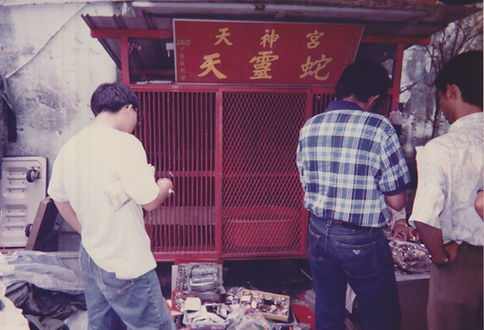
Opium Deity at Pasar Lane
At the Chinese temple on Pasar Lane, an unusual altar stood out, one that featured a deity with its tongue sticking out. Locals referred to it as the "Opium Deity." The figure’s protruding tongue was often smeared with a sticky substance believed to be opium.
During temple rituals, the medium who channeled this deity would frequently enter a trance, demanding opium offerings as part of the ceremony. It was a striking, even eerie, sight, one that reflected the deep entanglement of opium with aspects of spiritual belief and daily life in earlier times.
However, when the government launched a crackdown on drugs, including opium, the supply vanished almost overnight. What became of the deity's “needs” after that remains a mystery, lost to time.
Pasar Lane: More Than a Market
Pasar Lane was not just a place for the housewives to buy their daily essentials. It was also a hub of community life. Housewives would gather there not only to buy groceries but to exchange news, gossip, and stories. These informal exchanges became a vital channel of communication. They then return home to inform their husbands about what is happening in the world.
*
"News with Females travels faster than Emails."

A video overview of the Hinghwa enclave also known as "Kek Sng Kio".
Please view it with discretion.

The Challenges
(Swim or Sink)
When the migrants arrived, they quickly discovered that life was no bed of roses. To survive, they had to adapt fast. Many took on jobs that no one else wanted -- working as coolies or pulling rickshaws. Along the way, they often had to band together to protect their livelihoods, both within and beyond the neighborhood. This was where life could become especially tough.
*
There was nothing "cool" about being a coolie. Their work was grueling, with long hours and tough conditions. They were divided into two categories: Free Coolies and Credit Coolies.
-
Free Coolies were those who had paid for their own passage to the region.
-
Credit Coolies, on the other hand, were usually penniless and had their passage paid for by human traffickers, often referred to as middlemen.
The Credit Coolies became indebted to these middlemen, who would not pay the workers directly but instead paid the middlemen. The middlemen would then take their commission and receive installment payments. In many cases, these debts could last for years. Some companies, through middlemen, paid for the migrants' trip to Singapore. In exchange, the workers were expected to provide labor in return for basic necessities like food, but they were not paid a wage until their debts were fully settled. Once the debts were paid off, they were free to leave, but many were glad to get away from the harsh conditions. According to historian Sir Song Ong Siang, some laborers were paid as little as one Rupee a day, which is equivalent to around S$0.015 today.
As a result, many coolies lived in extremely poor conditions. Former Housing Minister Lim Kim San once expressed his shock at seeing people living under staircases in the slums of Chinatown. I, too, have witnessed similar conditions within the Hinghwa enclave, a stark reminder of the hardships faced by early migrants.
Many coolies, trishaw riders, and low-wage earners lived at Nos. 96 Sungei Road, sharing communal bathing and toilet facilities. More than 10 men would often bathe at the same time, sharing only two toilet cubicles. The conditions behind the rows of pre-war shophouses along Weld Road and Jalan Besar were similarly poor, with Hinghwa families living in small cubicles, often with as many as 30 people in a single living space, with 5 to 8 children in each family.
Like all slums all over the world, it is often home to gangs, violence, and vices.
*

AI-generated illustration of gangsters with tattoos.
Source: OpenAi
The illustration of gangsters with knives and guns may seem unrealistic, but this was the reality in Singapore until the mid-1970s, when strict law enforcement measures brought an end to rampant robberies, kidnappings, and shootings. Most of these crimes were committed by organized gangs. The Arms Offences Act of 1973 made the possession or trafficking of arms or ammunition illegal. Penalties ranged from a minimum of five years' imprisonment and caning to the death penalty.
*
Triad Societies and Secret Societies (黑社會)
Note: This is a third party video. Please view it at your discretion.
The Triad Society (三合会) is a well-known group that symbolizes the harmonious balance between Heaven, Earth, and Humanity. It originated in China, where it was initially formed to overthrow the Qing Dynasty, which was ruled by the Manchus.
The Triads are organized societies that adhere to a strict code of conduct. To join, an individual must undergo an initiation ceremony, during which they swear an oath of allegiance to the group. The most significant part of this ceremony involves loyalty to the gang. New members are bound together as "blood brothers" after drinking from a cup stained with a drop of blood from each member, symbolizing a solemn pact. Betrayal or disloyalty to the gang is met with severe consequences, often leading to dire repercussions. Due to their secretive nature and eventually their involvement in criminal activities, they became known as 'Or Sia Hui' (黑社會; Black Societies).
However, in the early days, these societies played a different role. They were primarily formed to assist their fellow countrymen in settling into their new lives in foreign lands, offering a sense of community and protection to the newly arrived migrants.
In Singapore and the Straits Settlements, the British colonial authorities sought to contain the violence and regulate these groups by registering them as 'Hoeys' (公会; Gōnghuì) or Chinese societies under Section 10 of Ordinance IV of 1885, a piece of colonial legislation. This registration allowed the British to monitor the activities of the societies more closely, although it also recognized their existence in a more controlled environment.
*
A detective once remarked that some of these triad members were "hard rocks" -- they would never snitch, knowing it would be a death sentence within the triad.
The statement is absolutely true. In the world of the Triads and similar organizations, loyalty is paramount, and breaking that loyalty, especially by "snitching" or cooperating with authorities, is considered one of the gravest offenses. The penalty for such betrayal could indeed be severe, often leading to violence or even death.
---
One such case is believed to have taken place inside the Capitol Theatre some five decades ago. According to news reports, a cinema-goer was found slumped in his seat after the movie ended. It was only when the lights came on that those nearby realised something was terribly wrong.
The police later revealed that the man had been murdered during the screening. They suspected the involvement of two assailants and believed it to be a gang-related execution. As the perpetrators were never identified, investigators concluded it was likely a professional hit.
---
The term "hard rock" is used to describe individuals who are unyielding in their loyalty to the gang and will never reveal secrets or betray their brothers. These members are known for their toughness and commitment, even in the face of extreme pressure. The culture of silence and unwavering loyalty in these societies, often reinforced by fear and tradition, makes it incredibly difficult for law enforcement to infiltrate or break them down. This is why organized crime groups like the Triads have such enduring power and influence.
In many ways, the code of silence (also known as "Omerutà" オメルタ in Japanese Yakuza culture) is a key factor in their survival. It creates a strong sense of community among members, but also a deep sense of fear among outsiders -- both law enforcement and civilians.
It’s fascinating to think about the complex networks and the sheer level of discipline and solidarity that these groups can maintain, even when operating in dangerous and illegal environments.
*
Pride and Underworld Status
Sometimes, it’s pride and status that fuel their bravado. As Singapore's top criminal lawyer, Subhas Anandan, once remarked, "Some of these guys feel proud of what they did." Some of these guys who have been jailed and caned often make a point of letting others know, using fear as a warning not to cross them. One such figure was a mechanic at a workshop. He was loud, abrasive, and frequently boasted about his time in prison, proudly claiming he had received three strokes of the cane. It was no surprise they called him “Sergeant.”
*
Hinghwa 'Gi Tong Hin'
Secret Society Membership Card

Source: National Museum/Singapore police Force
Hinghwa Secret Society
As “Sin Keks”, or new arrivals who came later than other Chinese immigrants in Singapore, the Hinghwa community also formed a kongsi (company or gang) known as “Gi Tong Hin.” This group issued membership cards and was purportedly a benevolent kongsi aimed at serving its members’ needs -- securing lodging, finding job opportunities, offering protection, and even arranging and performing last rites for deceased members (see 'Bang' Structure).
The Hinghua were among the last waves of immigrants to arrive from China. By then, Chinese gangs were already well-established and deeply entrenched in Singapore by the early 1900s.
Drawn by the strength of numbers, many were inadvertently pulled into the world of lucrative organized gang activities. Different gangs staked out their respective territories, leading to turf wars, violent disputes, and clashes that often resulted in serious injuries or death.
One of the most troublesome gangs to the new immigrants was known as Shang Luo Ping An (上落平安). They had a reputation for pilfering the luggage of travelers -- whether they were arriving or departing (Wynne, 2000, p. 402).
Attempts to legalize these groups proved futile, as gangland violence intensified in both frequency and brutality. The earliest recorded gang clash in Singapore dates back to 1824.
*
Japanese Occupation
The Japanese war that lasted from 1942 to 1945 brought devastation to lives, homes, and businesses across the Asia Pacific region, including the Nanyang.
In a strange twist of fate, those who had fled the chaos in their homeland of China soon found that the Nanyang was no safer, as they found themselves bombarded by the Japanese in their adopted country. Singapore fell to the Japanese on 15 February 1942, which coincided with the beginning of the Chinese New Year.
This was deeply ironic because the Japanese pirates had also carried out a massacre in Putian around the Chinese New Year period, during the Ming Dynasty. The Japanese invasion of Singapore almost seemed as though they were chasing the Hinghwa people all the way to the Nanyang. I now understand why my mum and many others who were on the same boat with her celebrated Chinese New Year with such emotion and gratitude for another year of peace and prosperity.
The month-long Nanjing Massacre in December 1937 was a prelude to the horrors that followed, as Japanese forces advanced toward Southeast Asia.
Every country around the Nanyang was bombed indiscriminately. Every businessman that I've encountered from that time told me that they lost everything.
My mum used to tell me about the horrors of the Japanese war, how Japanese warplanes rained bullets from the sky, and how a bullet once shot through the roof and pierced her pillow while she slept. She was soon forced to hide in the narrow drain outside, along with my beloved eldest (adopted) sister. Their only protection was a small concrete slab across the drain in front of each shophouse.
The Sook Ching Massacre (肃清 / 肅清)
The term in Chinese was originally understood as to eradicate the Chinese because they supported China during the Japanese invasion of China. However, the term was later translated as 'eradicate the bad influence' or to eradicate those who support China. Whichever way it is translated, it is still a massacre that remains as Singapore's and the region's darkest history.
,
The Sook Ching Massacre in Singapore stands as a stark and tragic reminder of earlier atrocities, such as the Nanjing Massacre in China, and those in Putian, Fujian Province, China during the Ming Dynasty, when Japanese pirates massacred the Hinghua people and their southern compatriots during Chinese New Year.
In Singapore, a memorial site in Chinatown marks one of the locations where the Kempeitai, the Japanese military police, conducted screenings of young Chinese men rounded up across the island. Those identified as anti-Japanese or deemed threats were taken to various massacre sites scattered throughout the many beaches in Singapore.
One young man who narrowly escaped this fate was Lee Kuan Yew, who later became Singapore's first prime minister. He was then 19 years old. Just as he was about to board the lorry to be taken to the execution site, he told a Japanese soldier that he needed to retrieve his clothes and was allowed to leave. His mother’s regular rickshaw puller, Koh Teong Koo, from the HockChia ethnic group, later helped him hide at his quarters on 75/77 Maude Road. That escape would prove pivotal: Lee did not join the many others who were transported to execution sites along Singapore’s beaches. The course of Singapore’s history might have been profoundly different had he not survived.
On a brief note of reflection, while it is true that no one is indispensable, it is also true that not everyone is easily replaceable. Lee Kuan Yew was one such figure. Billionaire Charlie Munger admired him so much that he kept a bust of Lee in his office.
*
The Man Who Saved Lee Kuan Yew
Note: This is a third party video. Please view it at your discretion.

Mr. Koh Teong Koo and family
Source: SGHardtruth.

North Bridge Road, near Upp. Cross Street
Source: Jason Ong

Junction of North Bridge Road and Upp. Cross Street.
Source: Jason Ong
War Heroes and Heroines
In war, heroes are born. Many men and women answered the call to return home and defend the motherland. One of them was a Hinghwa woman fighter pilot, while others served as mechanics, including a humble lorry driver whose ability to keep the vehicle running through China’s mountainous terrain was just as crucial as the efforts of those on the front lines. Another was Tan Seok Hwa, the daughter of Tan Xun Yi. While her father fought the Japanese in China, she fought the Japanese in Malaysia, where her bravery also made a mark in the resistance.
*

Patriot from the Nanyang
This moving history stands as a testament to the resilience of Chinese culture. Many of those who returned to defend their motherland, China, were impoverished migrants. They answered the battle cry because loyalty was sacred to them.
They join the famous Nanyang Volunteers / 南侨机工) who gave up what little comfort they had built in Southeast Asia to face danger out of sheer devotion.
This is a third party video. Please view with discretion.
Post War Gang Menace
Soon after the war ended in 1945, gang activities returned with a vengeance.
According to Retired Police Superintendent Lee Swee Thin, in the 1950s, there were as many as 120 gangs and over 10,000 active secret society members in Singapore. More than a thousand gangsters were arrested each year.
The Hinghwa living along Weld Road were plagued by the '24' secret society groups, notably ‘969’, ‘Gi Leng Hor’, ‘Or Peh’, and ‘Loh Kuan’. The headmen of both the ‘969’ and ‘Gi Leng Hor’ societies were Hinghwa, and their gangs included members from other dialect groups as well. The ‘969’ members operated out of the living quarters behind the Masjid Bawean Kampong Kapor Mosque.
Besides gang clashes, the groups were involved in robbery, housebreaking, and theft, but they were primarily engaged in the smuggling of contraband cigarettes from nearby Indonesian islands. The ‘Gi Leng Hor’ gang also ran protection rackets, illegal horse betting, Chap Ji Kee, 4-D lotteries, gambling dens, and other peripheral criminal activities.
These underworld operations frequently led to violent disputes with rival gangs from other parts of Singapore. Often, these disputes escalated into full-blown street battles, with gang members armed with parangs, bearing scrapers, daggers, wooden poles, and other makeshift weapons, storming into Weld Road in the evenings and indiscriminately attacking youths and men along the road and inside premises.
Naturally, the Weld Road gangs fought back fiercely, using their own assortment of weapons to defend their turf. As a result, many were injured -- some seriously -- and a number succumbed to their wounds. Numerous secret society members were arrested, prosecuted, or detained under the Criminal Law (Temporary Provisions) Ordinance of 1955, which empowered authorities to detain suspected gangsters without trial. Detainees had no knowledge of when -- or if -- they would be released.
According to a notorious gangster, the fear and uncertainty of indefinite detention were what ultimately broke the back of gangsterism in Singapore.
Contributions: Gang stories by Supt (Ret.) Lee Swee Thin
*
Kidnappings and Firearm Offences in Post-War Singapore
Kidnappings were rampant in the aftermath of the Second World War and escalated further during the 1960s. This rise persisted despite the enactment of the Kidnapping Act in 1961, which introduced the death penalty. Undeterred, most kidnappers, often desperate and dangerous men, had no qualms about using firearms when cornered, or even killing their victims after collecting the ransom.
A serial criminal once threatened his hostage, a police officer, with chilling words: "Today, it’s either you or me." Unfortunately for him, the officer, held at gunpoint, managed to wrestle back his revolver and fatally shot the gangster.
While some officers survived such close encounters, others paid the ultimate price in the line of duty. One such hero was Inspector Allan Lim Kim Sai, who lost his life in a dramatic shootout with the notorious gunman Morgan Teo.
One of the most notorious kidnappers of the time was Oh Kim Kee, who was wanted for a string of abductions and murders. His criminal spree ended in a blaze of gunfire when he was shot dead in a police raid at his Geylang hideout.
Among the most widely reported cases was the abduction of Ong Cheng Siang, a Hinghwa businessman and owner of the Green Bus Company. Though he was eventually released after a ransom was paid, the traumatic ordeal haunted him for years. Determined to contribute to a safer society, his grandson Patrick Ong later joined the public service and rose to become the ICA’s Head of Strategic Communications and Media Relations.
As kidnappers were frequently armed, and with a sharp rise in firearm-related crimes, including bank and goldsmith robberies, the government introduced the Arms Offences Act in 1973. Under this law, the use or attempted use of an illegal firearm, regardless of intent, carried the mandatory death penalty.
The kidnappers and the underworld boss
These tough measures proved effective. Kidnappings and firearm-related offences dropped sharply. Deprived of guns, criminals found it nearly impossible to intimidate their targets. As the saying went, “Without a gun, the towkay would just laugh at you.”
In one particularly telling case, two would-be kidnappers learned this the hard way when their intended victim fought back with nothing but his fists. Ironically, and somewhat comically, it was the kidnappers who ended up fleeing.
Fortunately for them, their victim turned out to be not just a martial arts expert, but an underworld boss.
*
Police drama at the traffic junction.

Source: Jason Ong
Source: Jason Ong
During my growing-up years, I witnessed all kinds of violence -- social unrest, political unrest, gang clashes, racial riots, stabbings, slashing, and even gunfire. One of the most unforgettable incidents was when a man ran past me, followed shortly by another man holding a gun with blood streaming down his face. I was then a mechanic sitting outside the motor workshop (4th from the right).
Out of curiosity, I decided to follow them. The man with the gun appeared to see the suspect run into a sauce factory just before the mosque on Weld Road, a few doors away from where I lived.
The passage leading to the sauce factory, also leads to the living quarters behind the mosque. The factory was secured by three main metal gates. The first gate leads down a passage to a second gate. Within this second gate was the customer service section, where various sauces were displayed for sale. Customers were not allowed to proceed beyond this point, as a third gate led directly to the owner’s private residence.
There was also a fourth gate, located to the left just before the second gate. This gate provided access to the rear of the nearby mosque. From there, one could either exit to the opposite side of the mosque or continue through a dark and narrow alley, right behind the mosque, that led to the living quarters.
The guy with the gun instinctively ran to the other side of the mosque to cut off the suspect’s escape route. With gun drawn, he signaled for me to move away, and I did.
Later, I found out that the man with the gun was actually a plainclothes detective. The suspect never emerged from the back of the mosque; most likely, he had slipped into the alley behind it that led to the living quarters. From there, he could have escaped in multiple directions, including toward Sungei Road or Jalan Besar, where Sim Lim Tower now stands. Before long, the entire area was swarming with police.
I later learned that the detective had been having a drink in a nearby bar when he spotted the wanted man on a motorbike at the traffic junction, someone he recognized as a notorious criminal.
To prevent him from escaping, the detective first cuffed one end of the handcuffs to his own wrist and then dashed toward the man to cuff him as well. A fierce struggle broke out between the hunter and the hunted. The fight must have been intense because the handcuffs broke, allowing the suspect to escape.
Rumours then were that the hunted was the guy who would run around the neighbourhood with a lighted joss-stick, and would stop when the foot-long joss-stick was burnt out. This would mean about an hour of jogging every morning. Though I have heard about his supernatural feat, I've never seen him in person.
Only recently did I learn that the man's name was "Ah Ter". He was arrested several months later after the escape and was eventually sent to jail.
NOT ALL GANG MEMBERS ARE BAD PEOPLE
Despite everything I’ve witnessed, several encounters have convinced me that not everyone involved in a gang is inherently bad. Some are simply products of their environment, young people who got caught up with the wrong crowd or a momentary loss of good judgment. I’d like to share three of their stories.
Case 1: A Chief Gangster who was not meant to be.
While passing by a bus stop along Bukit Timah Road, I chanced upon a neighbourhood acquaintance waiting for a bus. I was wary of his sight because I had heard that he had become a chief gangster. So, when he flashed a 'V' sign with his fingers and said, “Peace, brother,” I found it a little strange.
He invited me to have a chat with him. After a brief exchange of pleasantries, he repeated, “From now on, it’s peace, brother.” This was during the Hippie era, a time when many young people were drawn into a culture of free sex and booze. But the hippie culture and gang culture didn’t mix well; it was like rock and tofu.
Curious, I asked what that was all about. In a slightly flustered voice, he told me he had just been involved in a 'gangland settlement talk' at a hawker centre, along Bukit Timah Road. He said he couldn’t believe his eyes when he saw the other gang jumping out of lorries. He froze momentarily but managed to put up a brave front. Soon, he and his gang were surrounded. Many of the rival members were carrying objects wrapped in newspapers. He instinctively knew that inside those newspapers were parangs (long knives used to cut open coconuts).
I asked him how big the other gang was. “Around a hundred of them,” he replied. I gasped. It was no wonder the place had cleared out; many patrons, sensing trouble, had hurriedly left their plates of unfinished food and drinks. Then I asked how big his gang was. He looked at me and said, “Just me and my deputy.”
It sounded like something out of a gangland comedy.
Curious, I asked who the other gang was. He promptly said, "Gao Lak Gao" or “969.” That name sounded familiar; it was the Hinghwa gang that operated out of my childhood playground, Weld Road, though I kept that to myself.
We never met again after he boarded his bus. Looking back, I think it was probably a good thing for him. He never struck me as the violent type. I was glad that he came to his senses early.
[He reminded me of the Chinese idiom 井底之蛙, a frog in a well who believes the well is the entire world, until one day, he glimpses the vast world beyond.]
Case 2: A Gangster with Eyes of an Owl.
One evening, in 1972, I was walking home in my army uniform when I heard a voice calling out to me. As I turned my head, I saw a familiar face -- his large, round eyes can be quite intimidating.
His voice was sombre, which struck me as unusual, knowing him to be a loud and aggressive gang member. I was about 2 or 3 years younger than him. So, I was like a little boy to him, and he treated me as such, in a condescending manner. From my experience with people like them, he must have just been released from the police lock-up where he was 'polished up' as his fellow gang member would say. He was curious about what army life was like. I told him it wasn’t too bad.
I was surprised when he complimented me for being able to join the army. Caught off guard, I told him he should consider joining, too. In a soft voice, tinged with deep regret, he said he couldn’t because he already had a bad police record. He sighed and remarked that if he continued with gang life, he would either die young or end up in prison. I felt sorry for him, but I didn’t know how to help. After a short while, we parted ways. Decades later, I met him again. He called out to me while having his meal at a hawker centre. I was glad to hear that he had finally left the gang after serving a stint in prison.
Case 3: A Gangster Who Could Have Been a Police Inspector
He was tall, handsome, and quite intelligent. At one point, he was even training to become a police officer. I still remember the admiration I felt when I saw him in his officer cadet uniform; he looked every bit the part.
But his life took a dramatic turn. Under the pressure of peers who mocked him for being on “the other side”, the side that might one day arrest them, he gave in. His misplaced sense of loyalty led him down a path he would come to regret deeply.
Knowing him, it’s hard to reconcile that choice. He was kind-hearted, almost to a fault. As I reflect on his misjudgment, I sometimes think he would have made a better monk than a gangster.
Still, I believe everyone deserves a second chance.
---
Link to the video of a former Chief Gangster
This is a third-party video. Please view it with discretion.
*
Drug Scene

AI-generated illustration of Opium Dens. It is often dimly lit and smoky.
Source: OpenAi
The opium scene in Singapore began in the early 20th century. It was legal under the British administration, which was then supplying China with shiploads of opium in exchange for tea and silk.
Although opium dens were spread across the island, some were located within the Hinghwa enclave in Sungei Road, Weld Road, and the surrounding areas. These dens were places where addicts gathered to smoke opium with their peers.
Chains of misery of addiction
The social impact was devastating, not only to the addicts but also to their family members. Many had to sell off their possessions to feed their addiction, eventually losing their homes and resorting to criminal activities to sustain their habit.
The Hinghwa coolies, trishaw riders, and taxi drivers could barely afford their opium-smoking habit, which brought untold misery to themselves and their families.
In the early 1960s, opium addicts began to turn to a new drug called morphine. It was cheaper, easier to use, and provided instant euphoria. Consequently, the opium dens evolved into morphine dens, frequented by both long-time opium addicts and new morphine users. However, the suffering remained the same.
The locally born Hinghwa, having seen firsthand the misery and degradation brought about by opium and heroin, chose to stay away from drugs. Addicts were often despised by the community.
When Singapore broke away from Malaysia to become an independent country, drug dens were banned. Relentless police enforcement drove the trade underground, yet the problem worsened with the emergence of stronger drugs.
In the 1970s, drugs like Ganja, Heroin, MX, and Erimin 5 earned Weld Road the grim nickname of a “drug supermarket”, where drugs could be bought openly.
In a surreal scene, pretty girls, many from the entertainment industry, would arrive by taxi to buy their daily supply. The transactions were swift and subtle -- as the taxis slowed in front of the ‘Or Kow’ coffeeshop, dealers would approach, and with a flash, drugs and money exchanged hands.
Despite strict enforcement and heavy penalties, the drug problem persisted. The government was eventually compelled to introduce capital punishment, under which anyone caught with more than 15 grams of heroin was presumed to be a trafficker and could face the death penalty.
Tragically, the first person convicted under this new law was a Hinghwa woman, caught carrying a bag of heroin at the junction of Jalan Besar and Upper Weld Road.
The Hinghwa community was stunned and deeply saddened. Yet, the drug crisis continued.
As a pioneer volunteer counsellor for drug rehabilitation, I knew firsthand the struggles addicts faced in trying to quit.
Fishing
The word is a metaphor for people getting hooked on drugs.
This is often how it happens. Well-dressed and eloquent drug pushers often frequent places like pubs, discos, bars, and nightclubs, venues typically patronized by the more affluent and those looking to relax and enjoy themselves. In such an atmosphere, where everyone is out to have fun, people can be more open to experimenting, especially when encouraged by someone charismatic.
The pusher begins by befriending their targets. Once a friendship is formed, the drugs are introduced, often for free.
Most people accept out of curiosity. After all, it’s free, so why not give it a try?
Just one puff of ganja can induce a euphoric high, a sensation of being lifted into another world. Many want to return to that feeling again and again. And they do, until they're hooked. Once the dependency forms, the drugs are no longer free.
This is where the downward spiral begins. It’s no longer about chasing euphoria; it becomes about avoiding the agony of withdrawal. The craving intensifies, and many begin seeking stronger substances. This is when MX pills and, later, even more potent drugs like heroin enter the picture.
Ironically, “MX” stood for Merry Christmas, a grim twist of humour in a dark world.
Drug pushers who sell Ganja often don’t see themselves as drug dealers; they claim they’re just offering “herbs.” Those selling stronger substances sometimes call themselves “medicine men.” In their euphoric state, some users even find this absurdity amusing, encouraged by the pusher’s twisted sense of humour.
Note: Ganja, like cigarettes, is made from leaves. However, it contains compounds that trigger euphoria when inhaled. The danger lies in how easily one puff can lead to addiction, often opening the gateway to harder drugs. The descent into drug abuse is steep, and for many, the abyss has no bottom.
Drug addiction has no exit.
One addict once told me how he took an MX pill for the first time at a pub. He felt an overwhelming euphoria; everything looked and sounded unbelievably beautiful. The lights sparkled vividly, the music was mesmerizing, and the laughter around him was intoxicating. He described it as the happiest moment of his life.
Still ‘high’, he tried to leave the club. He saw the exit door, but strangely could not pass through it, continuously bumping into the glass panel beside it. The scene felt eerily similar to the song Hotel California by the Eagles, especially the last line that says:
When I was a volunteer counsellor working with drug addicts, I came to understand a painful truth from them: once they were hooked, quitting was no longer a matter of willpower; it became nearly impossible. That’s the true nature of addiction. It marks the beginning of a long, miserable journey that affects not only the addict but also everyone who loves them.
Contrary to popular belief, many addicts are not uneducated or from impoverished backgrounds. In fact, a significant number came from well-off families. This isn’t a coincidence; drug pushers often deliberately target affluent youth because they can afford to pay.
One case I dealt with was especially heartbreaking. The young man had every opportunity to live a comfortable and successful life; he could have had anything he wanted. But tragically, the only thing he truly wanted was drugs.
Another case I remember was an army colleague, who was incredibly good-looking, talented, and had a wonderful personality. He was the envy of many, always surrounded by beautiful girls. One day, he even brought me to his girlfriend’s home, a grand bungalow staffed with five or six amahs, female servants dressed in the traditional white tops and black pants, their hair neatly pony-tailed. That was how popular he was.
Years after we completed our national service, I learned from an inmate at a halfway house that he had become an addict. As I was a volunteer counsellor at that time, I naively went to visit him at his hideout, having heard that his family had disowned him. Sadly, he didn’t want to be contacted. I didn’t hear from him again until recently, when I learned he had passed away in a friend’s workplace, where he had been living out the last days of his life.
Many addicts became frequent inmates of rehabilitation centres or prisons. Outside prison, they would often commit crimes to fund their addiction, while some women were drawn into the vice trade.
A few committed heinous acts while under the influence of drugs. In Singapore, however, being high on drugs is not a valid legal defence. One such addict, convicted of a brutal murder while intoxicated, attempted to use his drug-induced state as a defence in court. His plea was rejected, and he was eventually hanged.
*
"You can check out anytime you like, but you can never leave." (Eagles, Hotel California)
Youtube link to Hotel California by Eagles Track 4:15
Note: This is a third party video. Please view it at your discretion.
Despite strict enforcement with capital punishment, the menace continued unabated. As the most recent police action shows.
Note: This is a third party video. Please view it at your discretion.

Amidst the storms of life, something interesting was beginning to rise on the horizon, BICYCLES!
Former Singapore Minister Mentor Lee Kuan Yew says,
Follow That Rainbow...
Note: This is a third party video. Please view it at your discretion.

Video Source: TikTok, Singapore Story
Image Source: Screen-grab from video.
This speech stands in stark contrast to what Singapore once was.
Singapore’s former Minister Mentor, Mr. Lee Kuan Yew, famously described the island as nothing more than “mudflats.” In those early days, Singapore was much like many other parts of the region -- underdeveloped, uncertain, and steeped in hardship. His words echo across the Nanyang, where similar stories of struggle played out.
For the early migrants, Mr. Lee’s vision of a modern metropolis must have seemed like a distant dream, as they endured the rough seas in bouncing boats -- penniless, anxious, and clinging only to hope.
Some would go on to fulfill their dreams. Others may not have lived to witness success, but their sacrifices built the foundations on which future generations would stand tall.
Today, the message is clear: the pioneers chose the right place, and through sheer perseverance and grit, they made it possible for the next generation to thrive.
It is no exaggeration to say -- they helped create the Golden Age of the Nanyang despite all odds.
*
Wheels of Fortune
Once they got on a bicycle, they pedaled furiously in search of that elusive
'grain of gold'.

AI-generated illustration of Centenarian Jason on a bicycle.
Source: OpenAi.
The catalyst of the pioneers was undoubtedly Yeow Wei Qi.
He was the first known Hinghwa to venture into the bicycle trade. His unselfish nature became the driving force -- quite literally -- that set the wheels of fortune in motion for his fellow clansmen.
With open arms, he invited friends, relatives, and family members to join him in the trade. And once it began, the momentum was unstoppable.
Soon, it seemed as though nearly every bicycle shop across the Nanyang bore the mark of Hinghwa ownership.
Under their capable hands, the wheels didn't just turn -- they grew bigger, faster, and more powerful.
What started with humble bicycles evolved into a movement.
In time, the Hinghwa came to dominate everything that moved on wheels, from rickshaws to buses.
*
Rickshaw in Beijing

Hitching a ride to the Qing Dynasty
Source: Jason Ong
Rickshaw services still operate today in some of Japan's tourist areas, preserved as cultural attractions that offer a glimpse into the past. The entire experience depends entirely on the rickshaw puller, who serves as the engine, accelerator, signal, horn, and brakes all in one.
In stark contrast, rickshaws were eventually banned from Singapore’s roads as they came to be seen as inhumane, a symbol of hardship and human burden.
Modern rickshaws in Japan are built with lighter materials, making them easier to pull compared to the heavier, more rugged versions once found across the Nanyang. Additionally, Japan’s cooler climate made rickshaw pulling more bearable than in the sweltering heat and humidity of Southeast Asia.
*
Bicycle
(We started with two wheels)
The Hinghwa referred to bicycles as ‘Kor Lia’. Yeow Wei Qi (姚为祺) became the pioneering figure in the bicycle and other transportation trades in the region. His knowledge of assembly and repair quickly expanded into other motor-related trades.
Trishaws
(Then we upgrade to three wheels)
The Hinghwa called the trishaw ‘Sor Lin Nyer’. The introduction of trishaws marked the first sign of transformation in the transport scene, and better things were to follow.
The first trishaw was officially registered in Singapore in 1914, although it had been in use as early as 1886. The trishaw became especially popular when the Japanese reintroduced it during their occupation of Singapore (Koh, Vincent, & Han, 2019a).
Tricycle
(We modify it to carry goods)
The Hinghwa called the cart-like vehicles ‘Zai hoh sor lin nia’, which meant ‘goods tricycle’. These vehicles became hugely popular, especially after the horse and bullock carts were banned from the streets. Many businesses couldn’t afford automobiles, so humans became the primary carriers of goods.
*

A model of trishaw at Changi International Airport, T2.
Motorcycles
(Back to two wheels but with an engine).
As motorcycles began to make their way into the transport industry, the Hinghwa quickly adapted. They transformed their bicycle repair shops into motorcycle repair shops. Robert Tan Bee Chuan, equipped with systematic management experience from Japanese companies, helped propel Ban Hock Hin to greater heights. Today, it stands as the largest motorcycle agency and repair shop in Singapore.
Taxis
(Then we upgrade to four wheels with an engine)
When Singapore became independent, the Hinghwa began to dominate the taxi trade. Many Hinghwa individuals became taxi owners, drivers, or both. Some even expanded their businesses and became fleet owners. However, with the eventual regulation of the taxi industry, the government imposed limits on taxi ownership, allowing only one taxi per owner and requiring a taxi driving license to own it. This marked the end of private fleet ownership, as NTUC Comfort took over the monopoly with better automobiles and services.
Mass Transportation
(Then we upgrade to buses that can bring many families for an outing together)
Before 1930, bus operations in Singapore were managed by the Singapore Traction Company (STC). By 1935, twelve Chinese bus companies were in operation. However, some of the bus crews became embroiled in political disputes, which led to frequent strikes. The infamous Hock Lee Bus riots highlighted the unrest and ultimately led the Singapore government to take over control of the bus industry. Today, the public bus service is operated by SBS Transit.
Spare Parts / Workshops / Tyres & Batteries
(Then we open related shops because all parts that run on wheels need to be serviced, repaired, or replaced)
An essential part of the vehicle trade involves spare parts, workshops, tyres, and batteries. Since all vehicles are subject to wear and tear, this led to the opening of many spare parts shops, particularly in and around the Hinghwa enclave. Many Hinghwa individuals found success in the import and export trade, as Singapore was a key entrepot for the region.
While spare parts companies acted as stockists, workshops provided vital services and repairs. This was a boom time for many Hinghwa people involved in the trade, contributing significantly to the local economy.
*
Resettlement
In 1978, a significant fire destroyed the two major living quarters at Sungei Road and the area behind the row of shophouses along Weld Road and Sungei Road. Following this, two additional fires made resettlement unavoidable. Consequently, the shophouses on both sides of Weld Road, as well as all those affected by the fires, were eventually relocated. This resettlement impacted the wider Hinghwa enclave that extended along Weld Road, Sungei Road, Kelantan Road, and Jalan Besar, followed by Queen Street, Ban San Street, and Rochor Canal Road. As a result, one of the largest Hinghwa enclaves disintegrated and dispersed to various parts of Singapore.
The resettlement of the Hinghwa enclaves in Weld Road, Sungei Road, and the surrounding areas was actually a blessing in disguise, remarked retired Hinghwa Police Superintendent Lee Swee Thin. “The area was plagued by secret societies and criminal activities that were not conducive to family living in general, and particularly for raising children. It caused many untold miseries and suffering for the affected Hinghwa community.”
*
The land that once was...

Jalan Besar MRT at the junction of Weld Road
Source: Jason Ong

Photograph taken from Sim Lim Tower shows the heart of the Hinghwa enclave, which was devastated by two major fires. The HDB apartments in the background are located at Kelantan Lane. The lower building is the present-day Jalan Besar MRT Station, situated at the junction of Weld Road. On the far right is the Rochor Canal. At the bottom right-hand corner was the site of a bread factory, with a furniture factory located next to it.
Source: Jason Ong

Legends:
1. Flea market.
2. Weld Road
3. Living quarters behind the row of shop houses along Weld Road/Sungei Road.
4. Sim Lim Tower
5. Sungei Road
6. Jalan Besar MRT (newly developed)
7. Jalan Besar
8. Kelantan Road
Source: Jason Ong
The Resettlement
Singapore’s Transformation Begins
(This is a third-party video. Please view it at your discretion).
The transformation of Singapore began shortly after it gained full independence in 1965 from Malaysia. As the nation’s first Prime Minister, Mr. Lee Kuan Yew boldly promised, “Never fear. In ten years, this nation will become a metropolis.”
This video captures the fulfillment of that vision, highlighting the development of Toa Payoh, then the largest residential and commercial project in Singapore.
At the time, Toa Payoh was a vast swamp, dotted with slums. To prepare the land for redevelopment, sand was imported from neighbouring countries. Barges transported the sand to Singapore’s eastern coast, where it was then rushed inland to the Toa Payoh construction site using lorries and a conveyor belt system that ran continuously, 24 hours a day. This massive operation not only reshaped the landscape but also provided thousands of jobs to the unemployed.
Upon completion, Toa Payoh became a beacon of progress. Many Singaporeans who had previously lived in overcrowded slums with poor lighting and sanitation finally moved into new homes, homes that offered privacy, proper lighting, and the simple luxury of flushing toilets. To them, it felt like paradise.
This was a blessing for those who urgently needed housing, such as victims of the fire, as Singapore's housing policies are designed to accommodate such emergencies.
*

Video source: Historyogi: Singapore History.
Image source: Screen-grab from video.
Mudflats to Metropolis
Singapore City Skyline from Costa Rhu
Source: Author
SINGAPORE TODAY

Source: Singapore Tourism Board
National Day Celebration
in the Heartlands
Source: Jason Ong
Fireworks in the heart of town.
Source: Author
My Childhood Adventure
