
Another project of the Hinghwa Heritage Centre
Malaysia
(including Sabah and Sarawak)

Peninsula Malaysia

Source: Malaysia Tourism Board
The Pioneers and Notables
(Malaysia)
The list of pioneers was featured in the 100th Anniversary Magazine of the Federation Heng Ann Association, Malaysia. However, in this section, I can only highlight a select few due to space and accessibility constraints.
The magazine also documented the Federation’s rich history and the various activities carried out over the past century. One topic of interest was why there appear to be significantly more Hinghwa migrants in Malaysia than in other regions -- particularly Singapore. A commonly speculated reason is the presence of greater opportunities with less competition during the early waves of migration.
As reflected in the Federation Heng Ann’s records, Hinghwa communities established themselves in every state across Peninsular Malaysia.
That said, the list of pioneers and notable figures in Malaysia remains incomplete. Many individuals are still unknown or untraceable due to gaps in historical records.
*
Help Me Unmask the Stories of our Pioneers

During my trips to Malaysia, I uncovered numerous names that deserve recognition. However, many of these individuals remain anonymous due to missing links or a lack of documentation.
I encourage descendants of these pioneers and community contributors to reach out to me -- especially if any names have been unintentionally omitted from this section. Your stories and connections could help fill in the missing pieces of our shared heritage.
*

A Special Message from Datuk Lim Wei Fook ,
President of the Federation of Heng Ann Associations of Malaysia
The Henghua history and culture have been conveyed through stories, but Dr. Jason Ong's research has revealed previously unknown aspects. His book covers the ancestors, history, culture, food, and some notable individuals of the Henghua community. This book will be valuable for future generations. The book can inspire younger Henghua people, especially those educated in English, to explore their heritage. It may help to unite Henghua people from various countries and regions within ASEAN. Young people might be motivated to join Henghua Associations in Malaysia and Singapore and connect with others.
Congratulations to Dr. Jason Ong for writing the books and creating this website dedicated to the Hinghua People.
Hinghwa in Malaysia
Malaysia is home to one of the largest Hinghwa populations in the Nanyang. One of the key reasons was the country’s abundant opportunities for land, agriculture, and employment, which attracted many early migrants seeking a better life.
Resilient and enterprising by nature, the Hinghwa pioneers soon began transforming jungles into padi fields, farms, and plantations. Those who preferred urban life found work as rickshaw pullers or labourers in the tin mines of the Kinta Valley in the northern state of Perak.
A turning point came when the pioneer Yeow Weiqi discovered the “wheels of fortune” in the bicycle trade. In the spirit of clan solidarity, he generously shared this opportunity with fellow clansmen. This simple yet transformative enterprise changed the fortunes of many Hinghwa families. Soon, they were pedalling across the length of the Malay Peninsula and even across the South China Sea to Sabah and Sarawak, establishing bicycle shops in towns and villages that welcomed them.
As their communities grew, the Hinghwa began building social structures and associations to support one another. Eventually, three respected elder clansmen travelled tirelessly across the country to unite the various Hinghwa associations under a single umbrella organisation — the Federation of Heng Ann Association Malaysia. In recognition of their wisdom and dedication, I have called these three elder leaders “the Three Sages of the Nanyang.” We are honoured to feature them together with members of the World of Eminent Hinghwas.
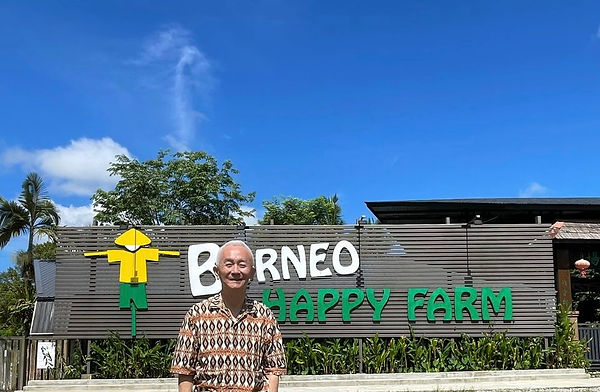
Source: JP Hong Boon Siong
The Hinghwa on Borneo Island
The presence of the Chinese on Borneo Island was memorialised in a street named after Ong Sum Ping (c. 1339–1408), a native of Quanzhou in Fujian, China. He was affectionately known as the “Raja of Boni” or the “King of Borneo.” His presence in Brunei was later attested to by Chinese visitors who discovered his grave bearing the inscription “黄森屏之墓,” translated as “The Grave of Ong Sum Ping.”
According to the Silsilah Raja Sulu, Ong Sum Ping arrived in Brunei in 1375. Legend relates that he journeyed there under orders from a Ming emperor to retrieve a precious pearl from Dragon Mountain (龙山) in Kinabalu, which at the time was part of the Brunei Sultanate. His tombstone suggests that he lived out his life and died in Brunei. The street named in his honour stands as a testament to the legacy he left behind (Lee, K.C., 2013, p. 532).
The island, however, underwent dramatic transformation in the centuries that followed. Persistent rebellions and shifting political forces gradually reshaped Borneo into distinct territories. In 1841, Sarawak—then under the Brunei Sultanate—was ceded to James Brooke (1803–1868) after he assisted the Sultan in suppressing local uprisings. Brooke later passed the state to his nephew, Charles Anthony Johnson Brooke, who became the second Rajah of Sarawak. In 1946, Sarawak was ceded to the British Crown, and in 1963 it became self-governing following British withdrawal, nearly a decade after the Japanese occupation.
During the Brooke and subsequent British administrations, increasing numbers of Chinese migrants made their way to the island. This movement was facilitated in part by the connections between Methodist missionaries and the Brooke government, as well as the broader networks linking Hong Kong, Malaya, and Singapore under British colonial rule.
With the arrival of these migrants, new towns began to emerge along the coastlines of Sabah, Sarawak, and Brunei Darussalam—many of which remain today. Among the later arrivals were two groups of Hinghwa migrants. One group reached Kuching through their own arrangements, while the other settled in Sibu with the assistance of Methodist missionaries. Over time, some moved northward to Bintulu, Miri, Brunei (now Brunei Darussalam), and Sabah (now part of East Malaysia).


A message from Mr. Hong Boon Siong (JP)
以史为鉴 文可载世
鄙人十分荣幸,获得来自新加坡同乡王顺龙博士的盛情邀请,亦特此感谢作者的美意;同时也对 他的勇气与努力“以文载世,以史为鉴,承先启后”为该新加坡新生代与时代青年提供机会,丰 富我们民族与同乡的经历与文化历史。
我感到十分欣慰,在其著作中能将我们砂拉越知名教育家;一生为民族教育事业服务工作者-已 故陈明聪乡贤的事迹纳入书中,不但丰富了其著作的内容,亦充份体现了人们的视野,让普遍被 视为“靠海为生,敢向大海挑战”的莆田兴化族群引以为傲!
我们中华民族是自有文字以来,在当今世界上,拥有最丰富历史的民族之一,是藉著我们拥有逾 五千年的历史与记载;我们也应饮水思源,感恩各别国家,历史与文化学者,考古学家,社会工 作者,传媒与著作家等的努力不懈。
我们更希望今天我们的国家与民族,应更重视各民族历史与文化习俗,让人们互相了解彼此之间 的文化与习俗深渊源;让我们感到欣慰的,今天我们除了对民族与文化历史有了新的认识,除了 印证历史文载外,人们也跃进一步深入考究有史之前所发生的事迹,对历史记载所造成的影响进 入深入的研讨,更加科学化。
我们不得不承认其中一个事实!历史记载可让我们了解“以史为鉴,可以了解国家兴替;以史为 镜可辩别真伪”的功用,今天我们的同乡王顺龙博士的著作与呈献,堪称“文可载世”,让我们 更深入与透彻国家与民族文化与历史的重要性!没有人能阻止历史巨轮向前迈进,但昨天的历史 与记载,却能给我们以“以史为鉴,承先启后”的机会。
祝愿:同乡王顺龙博士的著作成功付梓,一纸风行,洛阳纸贵。
中国著名思想家龚自珍說:(欲亡其國必先滅其史,欲滅其族先滅其文化)!
王兄是在为族人做保留根文化,大家都知道一旦根断了,一切历史和文化就会永远被埋藏在历史的长河中…永远也回不来了!正如我前面所言【文可戴世】王兄对族人尤其是莆田人的贡献很大啊!加油.
方文祥太平局绅

Kuching, Sarawak
Sarawak is the largest state in Malaysia and is home to one of the most notable Hinghwa communities. This community is primarily concentrated in the cities of Kuching, Sibu, Miri, and Bintulu.
In Kuching, there were two Hinghwa Temenggongs, one of whom has a street named after him. In Sibu, two notable Hinghwa also have streets dedicated to them.
The contributions of the Hinghwa community, along with their Chinese counterparts, have been instrumental in the development of Kuching. This was acknowledged on several occasions by the second Rajah, Charles Brooke, who publicly stated in 1883, “Without the Chinamen we can do nothing.”

Source: Author
The fishing boat located in the center of a roundabout in Bintawa, Kuching, Sarawak, symbolizes the livelihood of the Hinghwa people and their settlements.
There are primarily two groups of Hinghwa from different areas of Putian who settled in Kuching, Sarawak. Most of these individuals arrived at the beginning of the 20th century, although some may have arrived earlier.
The first group settled along the Sarawak River, where today we find Chinatown and Brooke's Dockyard. Later, some members of this community relocated further down the river to the Blacksmith Street and Petanak areas, forming a second Hinghwa enclave.
*
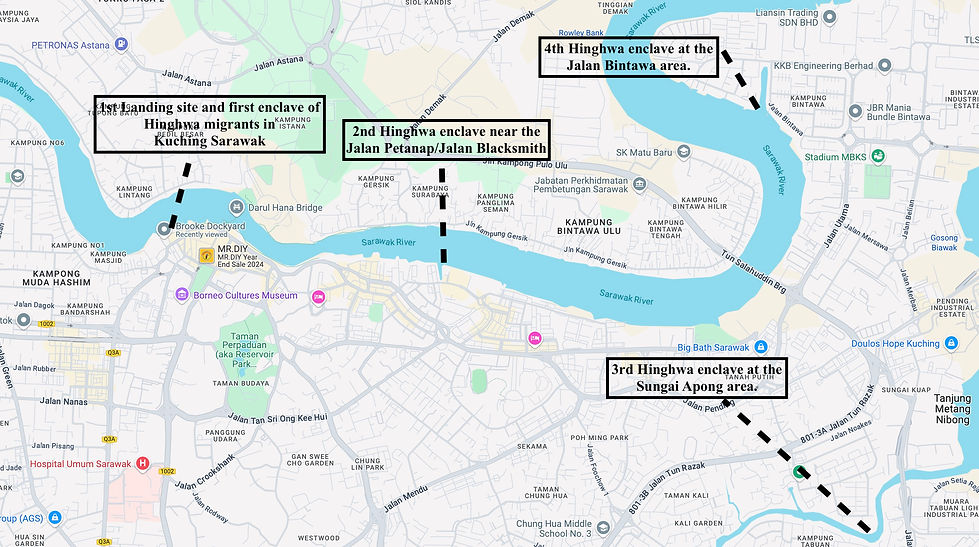
Hinghwa enclaves in Kuching, Sarawak
Source: Google Maps
Illustration by Author
Before long, another group moved to establish a third enclave in the Sungei Apong area, where a large sign reading "Kampung Sungai Apong Baru, Taman Heng Hua" was displayed. To maintain peace and harmony among the different groups, they were encouraged to form an organization called the "Kuching Henghua Co-operative Better-Living and Village Society Limited."
This frugal co-operative later expanded to include other associations, such as the Kuching Fishing Boat Association (古晋鱼船公会), the New Fishing Village Co-operative (新渔村合作社), and the New Fishing Village Chinese Primary School (Lim, K.S. pp. 35-37).
*
Another group eventually relocated to a different part of the river in the Bintawa area, where a fourth Hinghwa enclave was established. Over time, these various groups united to form the Kuching Hing Ann Association, which has maintained peace and harmony to this day.
Although most of the migrants were fishermen, many later ventured into the automobile trade, where they came to dominate approximately 95% of the transportation sector (Tien, 1983). Some became car distributors, while others entered property development. Additionally, some individuals emerged as public officials and community leaders, such as Temenggong Datuk Tan Meng Chong (天猛公拿督陈明聪) and Temenggong Lu Kim Yong (天猛公劉金榮).
The Temenggong holds significant power, with responsibilities believed to include ensuring the safety and security of the state, as well as protecting the rulers. In the early 19th century, during the signing of treaties between the Johor government and the British, it was the Temenggong who signed these agreements on behalf of the Johor government.
*

Source and Arrangements by Author
Kuching New Fishing Village Officials
---
新鱼村合作社 - 刘顺荣秘书
Xinyu Village Cooperative - Secretary Liu Shunrong
新鱼村合作社 - 刘文侯顧问
Xinyu Village Cooperative - Consultant Liu Wenhou
郑瑞福顧问
Consultant Zheng Ruifu
古晋鱼船公会 - 甲必丹陳国璋
Kuching Fishing Boat Association - Kapitan Chen Guozhang
---
For further reading and reference, please view the Publications section, which includes selected literature on the group and their village.
*
Note: This is a third-party video.
Please view it at your discretion.
A Glimpse of Kuching, Sarawak
Note: These are third-party videos.
Please view them at your discretion.
Visit Sarawak 2003
Kuching 1864
Kuching 1890
Kuching 1928
Kuching 1945 (Japanese Surrender)
Kuching 1945 (tiada cina tiada kedai)
Kuching 1950 (Native Nurses)
Kuching 1956
Kuching 1959
Kuching 1966
Kuching 1972 (Mini Skirt era)
Kuching 1975 (Airport)
Kuching 1976
Kuching 1994 (Chinatown, also First Hinghwa enclave)
Kuching 2004 (Heng Hua Fishing Boat)
Kuching 2023 (Perarakan Niti Daun, Sarawak Native)
Sarawak

The impressive copper tooling of the Hinghwa migrants arriving in Sibu, Sarawak was taken from the Hin Hua Centennial Park in Sibu.
Source: Author and Kapitan Frankie Nee
Sibu, Sarawak
Sungei Merah (Red River) is considered the first landing point for migrants arriving in Sibu, Sarawak.
Sibu is a town in Sarawak where many Chinese, including the Hinghwa, were brought by Methodist missionaries. Before the arrival of the Hinghwa, the missionaries, Rev. Brewster and Rev. Teng Bing Tiong, secured land from the Brookes in 1912 to build homes in Sungai Merah and Sungai Teku. After the land was secured, the missionaries accompanied two groups of Hinghwa to the area. Once settled, they began cultivating the land, which later became known as Hinghwa Land (兴化芭). Consequently, it is no surprise that the Hinghwa community in Sibu is predominantly Christian, and many still speak Hinghwa.
Those who arrived separately were also given land or a portion of the jungle to establish their own homes. However, the native mosquitoes, snakes, and wild animals made life exceedingly uncomfortable. As Lucy Siew recounted, “My grandparents came from Putian in the 1930s. They arrived with nothing more than the clothes on their backs. Uncertain of what lay ahead, they courageously sailed the high seas to escape the chaos of civil war, hoping for a better future.”
Upon arrival, they had to clear the virgin jungle to build their shelters, often sleeping on twigs and leaves. Those fortunate enough had gunnysacks to use as blankets. The only available food consisted of roots, leaves, or whatever they could forage. Adapting to a new environment brought many challenges, and the lack of necessities made young children vulnerable to illnesses, leading to tragic deaths. Some even had worms crawling out of their orifices after passing away. Despite these hardships, they eventually cleared the jungle to plant vegetables, potatoes, taro, gum, and cereals. They worked for six days and rested on the seventh to worship God in church. Over time, the jungle transformed into a town known as ‘Shiwu Hinghwaba’ or Sibu Hinghwa Village in Sungai Teku.
Lucy’s father longed to return to China. As the Chinese idiom says: "The leaves of a tree must return to their roots" (落叶归根). Even on his deathbed, he inquired about news from China, but his wish was never fulfilled, and he died feeling broken. Lucy’s mother faced the challenge of raising the children alone.
During these difficult times, some women suffered physical violence from their husbands, who released their frustrations on them. To survive, the women banded together with others from nearby regions, such as Miri. Their gathering resembled a 'Bang' structure in function, though on a smaller scale and less frequently.
Not long after China became a Republic, advertisements began appearing in Putian to recruit the poor for overseas work. By this time, the demand for laborers in the tin mines and rubber plantations in Malaysia was increasing rapidly, leading thousands to leave Putian.
Wherever they went, they transformed jungles into towns.
As Datuk Philip Lau King Kah, former president of the Hin Hua Pou Sen Association (Sibu), noted:
“从传统走向现代,由苦难走向光明,虽然是一条充满悲歌和崎岖的道路,但是,勤劳,刻苦和节位的生活美德和勇于冒险的开拓精神,却造就了兴化人无数的荣耀和功名.” (Wong, 2012c, p. 1).
The journey to modernity (for the Hinghwa people) may be filled with many hardships, tragedies. It has also created “countless glory and fame” through the hard work, life virtues and the pioneering spirit of our elders.
Indeed, many have achieved remarkable success; some have become the wealthiest individuals in the region, while others have been honored with prestigious Malay titles, ranging from Dato’ to Temenggong. Some have become Ministers, members of Parliament, and penghulu (village heads).
Sibu is home to many notable Hinghwa individuals. While it is impossible to mention them all, I feel compelled to highlight a few, fully aware that there are many others equally noteworthy, if not more so.
Some of the better-known Hinghwa in Sibu are: Teng Chin Hua (陈仁华), Rev. Teng Beng Tiong, and Rev. Ling Kai Cheng. Penghulu Yong Che Chong (杨志聪), and Lu Muong Huat (卢文發).
*
Hin Hua Pou Sen Association, Sibu
(诗巫兴化莆仙公会)
formerly known as Sibu Hin Hua Association
(诗巫兴化公会创会人)
Chairman, Penghulu Yong Che Chong (杨志聪).

Heading 6
Hin Hua Pou Sen Association, Sibu (诗巫兴化莆仙公会).
Source: Author & Kapitan Frankie Nee
On 5 April 1937, Rev. Ling Kai Cheng gathered the Hinghwa people at the Tiong Hin School, where he mooted the idea of setting up a Hin Hua Association (诗巫兴化公会) to foster mutual relationships (Ling, 2018, p. 56). Rev. Ling became its chairman for 3 years.
In 1958, it was renamed to Hin Hua Pou Sen Association, Sibu (诗巫兴化莆仙公会). The association is very active in promoting the Hin Hua culture and maintaining the cohesion of the Hinghwa people. To their credit, apart from constructing an impressive building for the association, they have developed a Hin Hua town with a church, schools, a centennial memorial park, and even a cemetery. Their committee members are still very fluent in the language, and they were cast in a video depicting the struggles of their Hinghwa pioneers.
I'm deeply grateful to their president and committee members for hosting my visit in 2023. I'm especially grateful to their secretary, Frankie Nee, who took much time off to show me around the rich Hin Hua heritage in Sibu.
The current Chairman is Penghulu Yong Che Chong (杨志聪).
The association is a member of the Federation of Heng Ann Association Malaysia.
*
A Glimpse of Sibu, Sarawak
Note: These are third-party videos.
Please view them at your discretion.
Miri, Sarawak
In Miri, Chang (2021) notes that by 1895, there were already a few wooden shops operated by Chinese traders, along with a lone Arab trader. These traders engaged in commerce with the Malays, or Mirieks, as early as the 1850s.
At that time, the population of the area was about 100 people. The discovery of oil in 1914 led to an influx of workers from Kuching, Sibu, Malaya, and Singapore.
The Hinghwa people began to settle in the area, bringing skills such as mechanics and taxi, and bus driving. Some of the more enterprising individuals opened shops that sold various types of vehicles, ranging from bicycles to motorcycles, and eventually to cars, buses, and lorries. Others took on roles such as barbers and engaged in other trades. Community records indicate that 22 Hinghwa families arrived in Miri.
According to Chang (2021), the current population of the Hinghwa community in Miri is about 2,000. Some members have also migrated across the border to Kuala Belait in Brunei.
Additionally, the Miri Hin Ann Association's Youth Section is a growing and active group within the community.
Miri Hin Ann Association
Mr. Li Ming Seng (李明森会长)
President of Miri Hin Ann Association
(美里兴安会馆)
2519, Jalan Boulevard 2a/1, MIRI, Sarawak.
*
A Glimpse of Miri, Sarawak
Note: These are third-party videos.
Please view them at your discretion.
*