
Another project of the Hinghwa Heritage Centre

Origin of Hinghwa
兴化人的起源
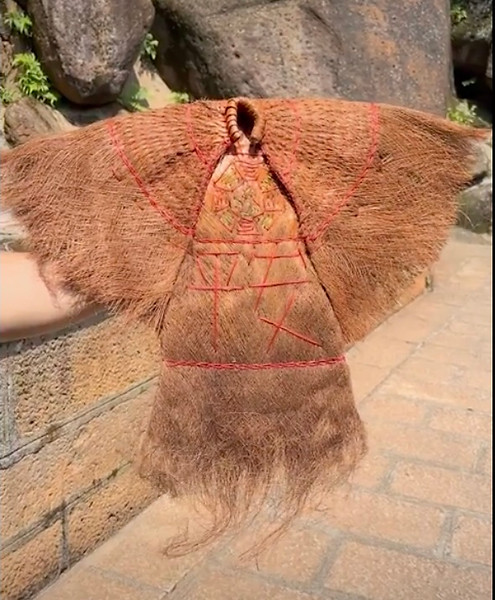
Ancient raincoat
Source: Author & Lin Zhou (林洲)
The image of an ancient raincoat offers a captivating window into the lives of the early Hinghwa people in what is now Putian. Intricately sewn onto the chest are a hexagram symbol and the Chinese characters 平安 (meaning “peace and safety”), elements rich with meaning and cultural significance.
These symbols likely reflected the deep yearning of the people at the time. Wearied by the toll of wars and natural calamities, they sought peace not just in their hearts but in every aspect of life, even in the garments they wore. The hexagram, possibly representing divine order, and the hopeful message of 平安 may have served as both a prayer and a silent plea: that the heavens might hear their cries for protection and grant them safety from conflict and disaster.
The fiber of the coat is believed to have been made from the sheaths of palm leaves. Though primitive in appearance, it reflects an early form of natural technology. This same material is still used today to make mattresses, prized for their ability to keep people warm in winter and cool in summer due to its natural heat-regulating properties. The raincoast likely served multiple purposes, providing protection not only from rain, but also from the seasonal extremes of heat and cold.
Origins and Migration of the Hinghwa People
The Hinghwa ethnic group, historically known as the 'Min' people, were originally located in the southern regions of China. Over time, they gradually merged with northern populations during the Warring States period.
During that era, the Yue and Chu kingdoms held power in the central and southern regions of present-day Zhejiang. At the time, Zhejiang included the northern part of today’s Fujian Province. After the Yue kingdom was defeated in battle, members of the Yue clan fled southward toward the 'Ou' (瓯) region, now known as Wenzhou in Zhejiang, near Fujian's northern border. The Yue ethnic group (越族) was also referred to as the YuYue (于越), as the surname of their king was 'Yu' (于).
Professor Chen C. Y. explains:
“During the Qin and Han dynasties, Han people continued their expansion southward into the Putian area. This southern migration occurred multiple times: first during the initial expansion, then during the Yongjia Rebellion (永嘉之乱), and again at the end of the Jin Dynasty following a peasant uprising.”
This migration led the people of the Ou region and the Yue ethnic group to move further south into the Min (Fujian) area. Historically, the Min people were also known as the "Southern Man" (南蛮), or southern tribal peoples. Through integration with other groups, a new ethnic identity gradually formed.
As Professor Chen, Dean of Putian University, states:
“The Hinghwa people belong to the Minyue ethnic group (闽越族).”
The earliest records of a city called "Min" in Fujian Province appear in the ancient Chinese encyclopedia The Classic of Mountains and Seas (Shan Hai Jing), specifically in Volume 10, The South of the Sea: “Fujian is in the sea, and there are mountains to the northwest. One day, Fujian Zhongshan is in the sea.”
(Huang, 2012a, p. 2).
This description aptly reflects the geography of Putian, which was historically inundated during high tides. The ancient Qiantian city is known today as Putian and Xianyou.
Fujian Province is typically divided into three major cultural and linguistic regions:
-
Mindong (闽东; Eastern Fujian): Encompasses the middle and lower Min River basin and the northeastern mountains, adjacent to the Taiwan Strait and the East China Sea.
-
Minnan (闽南; Southern Fujian): Refers to areas around the Jiulong River (九龙江) and Jin River Basin (晋江流域), also near the Taiwan Strait.
-
Minzhong (闽中; Central Fujian): Includes parts of Sanming City (三明市) and the Putian area, including Xianyou County (仙游县), Licheng District (荔城区), Chengxiang District (城厢区), Xiuyu District (秀屿区), and Hanjiang District (涵江区).
According to Professor Chen C. Y.:
“The Minyue ethnic group (闽越族) was composed of several ethnic lineages, and the Hinghwa clan was among them.”
He categorizes the Minyue group into three main components:
-
The indigenous Min tribes, known as the "Seven Min" (七闽) tribal alliances date back to the Shang and Zhou dynasties.
-
Southern migrants from the Yue royal clan and their followers.
-
People from the Chu kingdom who migrated to Fujian.
During the Shang and Zhou dynasties, the Putian area was under the administration of the Yang State (扬州), one of the seven regions of the Western Zhou. By the Qin Dynasty, it became part of the Minzhong Commandery (闽中郡). The name “Putian” did not exist at that time.
As the victorious Han army advanced southward, they gradually merged with the local Yue populations. During the Warring States period, the Min people and the YuYue ethnic group (于越族) fused into what became known as the Baiyue (百越). This fusion was documented by the historian Sima Qian.
Professor Chen affirms:
“The early ancestors of the Xinghua (Hinghwa) people were part of the Minyue ethnic group (闽越族).”
These people were among the earliest inhabitants of what would become the Putian region. Thus, it can be concluded that the Xinghua (Hinghwa) people originally belonged to the Minyue ethnic lineage.
According to Professor Chen:
“Before their integration with the Han from the north, the only recorded surnames among them were Lan (蓝), Lei (雷), Che (车), and Yi (蚁).”
Zhou (2008) further notes:
“During the Tang Dynasty, 30 surnames migrated to Putian, including Zhang (张), Fang (方), Mi (米), Chen (陈), Ye (叶), Qiu (邱), Zhan (詹), Xie (谢), and Fu (傅), especially in the Xianyou area.”
Migration, however, was an ongoing process. Over time, more surnames were introduced. This interaction between the northern migrants and the southern tribes was ultimately beneficial. The northern Han people brought advanced production technologies and cultural practices, contributing to the development of the southern regions.
After settling in Fujian, the Han people eventually formed seven major ethnic groups:
-
Xinghua people (兴化人; Xīnghuà rén)
-
Fuqing people (福清人)
-
Fuzhou (Hockchiu) people (福州人)
-
Jiannan people (间南人)
-
Minbei people (闽北人)
-
Hakka people (客家人)
-
Longyan people (龙岩人)
Each group developed its own dialect, often becoming as distinct as different "birds of a feather flocking together."
By around 900 AD, near the end of the Tang Dynasty, large-scale migrations from the north had begun to taper off. By that time, the Xinghua people had firmly established themselves in the Putian region and were rising in cultural and social prominence.
The expansion of the Han ethnic group across the central plains and further south during the Qin and Han dynasties led to the assimilation of many minority groups. This process contributed to the Han becoming the majority ethnicity in China. Intermarriage and cultural integration further accelerated this population growth and cohesion.
*
From the Ruins of Civilization, the Character
化
Emerged.


The Chinese character ‘化’ (huà) has a profound meaning and came to represent a people who were reputed to be deeply connected to education.
This image is believed to be an illustrative representation of the actual inscription found on an oracle bone. Zhihu (知乎), in its Interpretation of Oracle Bone Inscriptions, presents it as:
Ancient ‘化’
Source: Zhihu (2023)
Some people interpret the word Hinghwa (兴化) as "lucky people", because the word ‘化’ (huà) sounds very similar to ‘华’ (huá). In a sense, it is true that the Hinghwa people were fortunate to survive the worst of times and went on to triumph over adversity. This is perhaps an understatement for a people who survived three great calamities during the Yuan, Ming, and Qing Dynasties.
While the word ‘兴’ (xīng) means to rejuvenate, rise, flourish, or prosper, the word ‘化’ (huà) carries a deeper meaning when traced back through time.
The character ‘化’ evolved from an image first found on oracle bones during the Shang Dynasty (c. 1600–1046 BCE) (Dong, 2011b). It resembles two people with their backs to each other, placed vertically opposite, one standing upright facing left, the other upside down facing right.
This simple illustration conveys a profound meaning in Chinese thought. It can represent seeing things from a different perspective before reaching a conclusion.
It symbolizes fluidity or transformation in one’s perception. Over time, this evolved into the character ‘化’, which in a modern context means “to transform into a certain nature or state.”
In one of Lao Zi’s teachings, he advises one to be like water, that is, to adapt according to the circumstances. Ironically, this name befits the Hinghua people well, given their ingenuity in adapting to different environments, whether in times of prosperity or hardship.
This adaptability may explain why the Hinghua people were able to survive the many calamities that befell Putian and later re-emerge in the Nanyang region to play a significant role in ushering in its golden age.
The word 兴化 (Hinghua) was first used by Confucius in his teaching ‘兴盛教化’, which means “to prosper” and “to revitalize or educate” (Xinghua, n.d.). It can also mean enlightening people through education and culture.
In 979 AD, the term gained another meaning during the Song Dynasty’s Taiping era, when a region was carved out of Quanzhou and named Xinghua County.
The name was bestowed by Emperor Taizong, aka Zhao Jiong (趙炅). At the time, he sought to address the instability caused by peasants living in the outer regions. He believed that using education to uplift and civilize the people would be an effective strategy. This marked the first time the name Xinghua became associated with Putian, giving rise to the people known as ‘兴化人’ (Xinghua rén).
The name 兴化 (Hinghua) is said to be an abbreviation of ‘兴德化民’, meaning to educate and uplift the people through moral virtue.
This philosophy may have laid the foundation for the Hinghua people’s continued progress and their remarkable contributions throughout history. One of these was to earn the honorable title of "文献名邦,海滨邹鲁".
*
Note:
Xinghua County was carved out of Quanzhou in 979 AD and later became known as Putian. However, the name “Xinghua County” had already existed since 920 AD in Jiangsu.
To avoid confusion between the two regions, Xinghua County in Putian gradually came to be referred to simply as Putian, while Jiangsu retained the name Xinghua County.
In the Nanyang (Southeast Asia), the Xinghua people therefore identify their ancestral hometown as Putian rather than Xinghua.

Emperor Taizong, also known as Zhao Jiong (趙炅), bestowed the name ‘兴化’ (Xinghua) on a newly established county carved out of Quanzhou. This marked the first time the name Xinghua became associated with Putian, giving rise to the identity of the people known as ‘兴化人’ (Xinghua rén).
*
Emperor Taizong aka Zhao Jiong (趙炅)
Source: Hui Min

© 2025. Copyright Jason Ong
作者: 王顺龙, 新加坡
All Rights Reserved