
Another project of the Hinghwa Heritage Centre

History of Putian
蒲田的历史
Long before the arrival of the Han Chinese from the north, the land later known as Putian was already populated by its own indigenous inhabitants. These early communities were primarily located along the Mulan River and its estuary. As mentioned earlier, archaeologists have also discovered evidence of an ancient civilization on Nanri Island, off the coast of Putian, as well as in the Xinghua Bay area. This was where the first Hinghwa people were introduced to Christianity.
The ancient name of Putian (蒲田) evolved over time. The original Chinese word for Putian was indeed ‘蒲田’.
The character '蒲' (Pú) is composed of two elements. The top radical 艹 represents grass, while the bottom part 浦 means estuary or wetland, thus forming the meaning behind ‘蒲’ (Pú).
The second character, ‘田’ (Tián), means field or farm. Together, the term ‘蒲田’ (Putian) literally means “Wet Grass Field” or “Marshy Farmland.” The vegetation was described as grass because it clings to hard surfaces in shallow waters and reproduces there.
This aquatic plant is also known by its scientific name, Porphyra (紫菜).
Unlike typical seaweed, it does not drift with ocean currents and is known for its distinctive flavor when fried. According to Wang, Zhu, & Yao (2023), “It has high nutritional value, including antioxidant, immune-modulating, anti-aging, and hypoglycemic effects.” ScienceDirect also identifies it as a potential anti-diabetes agent.
*
Porphyra (ZiCai) Farming

Source: Zhou Beixuan with gratitude to Lin Zhou
As much of Putian was an estuarine region, a heavy downpour during high tide could easily cause the river to swell, resulting in widespread flooding. In times of such suffering, the people would seek answers from the spiritual realm. It was believed that the focus had fallen on the Chinese character ‘蒲’. According to legend, the three dots on the left side of the character resembled rain (雨), and in Feng Shui, it was considered a symbol of bad luck. Consequently, the three strokes were removed, and ‘蒲’ became ‘莆’.
Another theory suggested that the name was changed after the water was drained off (Liu, F. Z., 2014b). However, this theory is less likely, as the water level in the estuary is governed by tidal fluctuations.
Regardless of the origin of the name, what truly mattered to the people was that the land was fertile, something of utmost importance to the farmers who lived there (Zhou, 2008a).
In 568 AD, Putian was officially recognized as a geographic and administrative entity by Emperor Chen (Chen, C. Y., 2014a, p. 65).
Over time, the area became known as Hinghwa (兴化), Xing’an (兴安), Puxian (莆仙), Puyang (莆阳), and Licheng (荔城), reflecting the changes under various dynasties and local governments. The name Licheng (荔城) is actually derived from the lychee fruit, making it arguably the sweetest-sounding name, literally.
By the time Putian became Xing’an Prefecture, according to Professor Chen, many villages in the region already incorporated the word 'Pu', such as:
Púhǎicūn (莆海村), Púshàngcūn (莆上村), Púwěicūn (莆尾村), Shāpúcūn (沙莆村), Xiàpúcūn (下莆村), Dàpúcūn (大莆村), Xiǎopúcūn (小莆村), Púxīncūn (莆心村), Gāngpúcūn (冈莆村), Dàpútián (大莆田), Shàngpúwěi (上莆尾), Púgé (莆隔), Púshàngwéi (莆上围), Púxīnpái (莆心排), Cǎopúzi (草莆子), Kēngxiàpú (坑下莆), etc.
Similarly, when people from Putian migrated to other regions, they often gave new settlements the same name out of nostalgia and cultural continuity. This is why many regions, such as Chao'an and other coastal areas, feature the word ‘Pu’ in their names.
Each village typically consisted of around a hundred households. The Hinghwa villagers would fondly address each other with the phrase:
Duh lek hio li nan, nai kah yi.
我们都是同一个村。没有必要这么客气
Wǒmen dōu shì tóng yīgè cūn. Méiyǒu bìyào zhème kèqì
"We are from the same village, no need for such courtesy."
*
Putian Ancient City Entrance
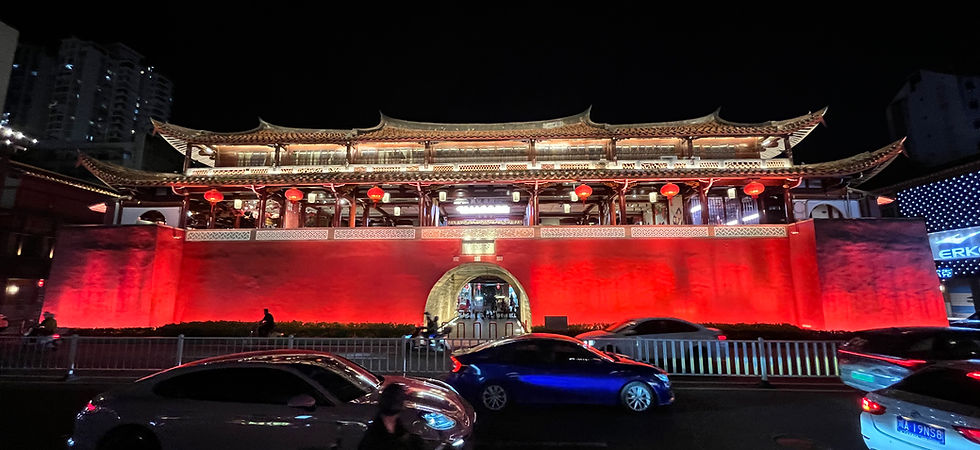
Source: Author & 林洲
Water Warriors
Putian was very much farmland in a low-lying area, where too much or too little water can be a disaster.
During a flood, heavy downpours swell the rivers, and when this coincides with rising tides at the estuary, a catastrophic flood becomes inevitable. Such floods can be disastrous, as unprecedented water levels may wipe out entire crops, severely impacting the people's economic well-being.
On the other hand, an extreme drought can cause crops to wither and die due to the absence of sufficient water, resulting in equally devastating losses.
Even people from outside the county could not bear to witness the suffering of the farmers. One such benevolent figure was Qian Si Niang. Lady Qian, along with those who followed in her footsteps, valiantly battled extreme weather conditions by constructing dykes, to mitigate flooding, and retain water for irrigation, and to ease the hardship of the drought season.
*
Qian Siniang (钱四娘; 1049AD – 1067AD)(Goddess of Water)
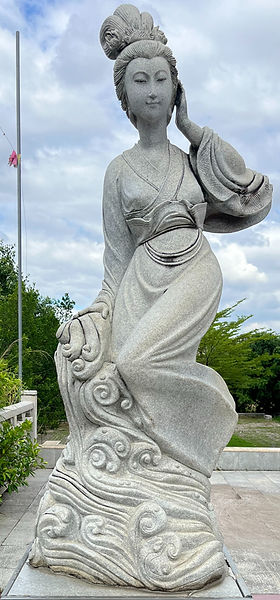
Source: Author & 林洲
Lady Qian was a native of Zhangle (长乐), Fujian. She came from a prestigious family of imperial officials and displayed remarkable talent from a young age. Her father held an official post in Guangdong Province. Lady Qian was widely revered for her selflessness, particularly for raising funds to assist the needy in Putian.
According to legend, while passing through Putian with her father, she witnessed widespread devastation across the farmland and the suffering of the local people. Deeply moved, she returned to her hometown and successfully raised funds to build a dam that would irrigate farmland along both sides of the Mulan River.
Without any government support, she later returned to Putian and spearheaded a private initiative to construct what would later be known as the Mulan Reservoir (木兰陂; Mùlán Bēi).
*
Mulan Bei Park

Source: Mulan Bei Park by Author & Lin Zhou (林洲)
The dam was finally completed. When the rain began to pour, the upper ridges of the dam began to fill with water. But suddenly, the dam collapsed. Devastated and heartbroken, Qian Si Niang could not accept that all the hard work put in by the migrant workers had come to nothing. Overwhelmed by sorrow, she threw herself into the water and tragically passed away at a very young age.
Her selfless dedication to helping the people of Putian deeply touched the hearts of the villagers, who continued to revere her as the Goddess of Water (水女神) (Li, S. H., 2012).
A nearby temple, 协应庙 (Xié Yìng Miào), was dedicated to two significant figures whom the villagers believed were worthy of divine recognition. They were 李长者 (Lǐ Zhǎngzhě), worshipped as the founder, and 钱四娘 (Qián Sìniáng), revered as a secondary goddess (Dean & Zheng, 2009, p. 15). The temple was later officially registered as a recognized place of worship.
What made her service so divine was not just her sacrifice, but the fact that no one asked her to help; she simply saw the suffering and gave everything she had to relieve it.
Her actions became a powerful symbol for many Hinghwa in Nanyang, who later returned home to build schools, roads, and infrastructure, and to invest in their hometowns for a better future.
Her sacrifice inspired others to continue her project. Several of these individuals were later honored in the Shi Hui Temple in Putian.
*
Mulan Bei in Putian

Source: Author & Lin Zhou (林洲)
Walking across the dam was quite an experience, largely due to the optical disorientation it caused. As the video shows, one side of the lake is calm and still, but as the water rushes into the dam and exits on the other side with a constant roar, the contrasting motion can be disorienting. The uneven stone surface beneath my feet only adds to the challenge of crossing.

I extend my deepest appreciation to Guardian of Hinghwa Heritage Lin Zhou (林洲) for generously sharing this site and his knowledge of the history of Putian with me. I am profoundly grateful for his kind hospitality and invaluable assistance throughout my 10 day study tour of Jiangdou (Fuqing), Putian, and Xianyou.
Source: Author & Lin Zhou (林洲)
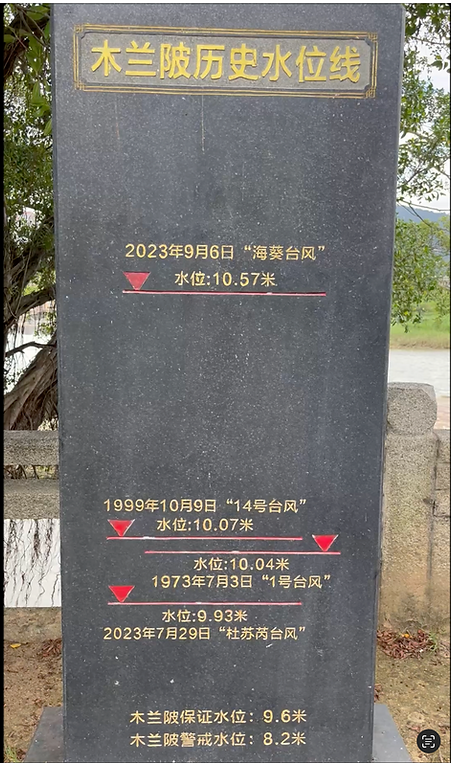
As the chart shows, in 2023, the floodwaters rose to an alarming 10.57 meters, the most devastating flood in modern Putian. Even with today’s advanced technology, the flood proved impossible to contain.
Now, imagine Lady Qian and her dedicated team of helpers, using only their bare hands and primitive tools, facing such powerful forces of nature. Their courage and determination were nothing short of extraordinary.
*
FLOOD IN PUTIAN

Source: Hong Lin
As the picture shows, the town was inundated with floodwaters in 2023. This mirrors the hardships farmers faced in the past, where their crops and livestock could be wiped out in an instant. It is for this reason that the people have always been deeply grateful to those who helped them survive such disasters.
This deep gratitude gave birth to the worship of more than a thousand deities, many of whom were, in fact, real individuals who had performed extraordinary deeds during their lifetimes. One such example is the Shihui Temple, which is nearly a thousand years old and stands as a lasting tribute to the enduring reverence for those who served the people with selflessness.
*
圖:世惠祠 (Shihui Temple)
來源:蔡建财 (Cai Jiancai)
Temple of Gratitude
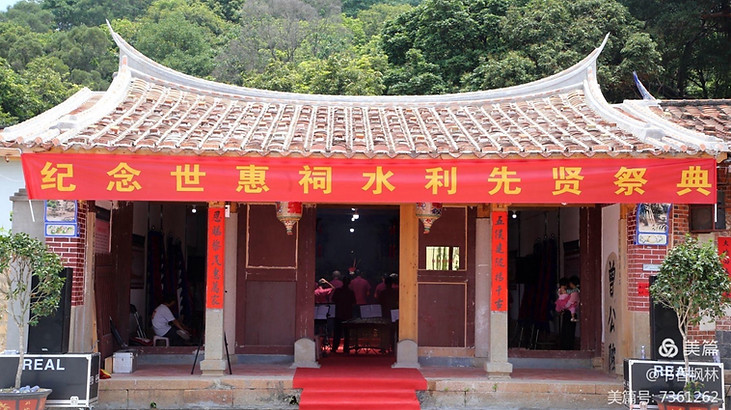
Source: Cai Jiancai
This humble temple houses the images of six revered sages who saved millions of lives and lifted countless others from hardship in ancient Putian.
In Putian, extreme weather has long wreaked havoc on the lives of farmers. Floods and droughts could easily wipe out a year's worth of crops, leading to famine and widespread suffering. Sometimes, droughts would last for years. To confront these twin disasters, courageous sages often rose to the occasion, constructing dams to control floodwaters and irrigate the land. With only primitive tools and the strength of human labor, their efforts were sometimes swept away by powerful water currents.
Disaster often struck when torrential rain coincided with high tide and thunderstorms, amplifying the destructive force. Even today, with advanced technology, catastrophic flooding remains an insurmountable challenge. While nature's power cannot be controlled, these ancient sages understood that water could at least be retained during times of drought or redirected during wet seasons to prevent loss.
This was the spirit that moved extraordinary sages such as He Yu (何玉), Cai Xiang (蔡襄), Liu E (刘谔), Zeng Yonghu (曾用虎), Zhang Nie (章蘖), and later Chen Chunming (陈春溟) to take action. They were the architects behind the life-saving water management systems of Shengshou Pond (胜寿塘), Taihe Pond (太和塘), Xichong Pond (西冲塘), Tunqian Pond (屯前塘), Dong Pond (东塘), and Taiping Dam (太平陂).
The temple dedicated to their legacy is known as the Temple of the Six Dukes (六公祠; Liù Gōng Cí). In ancient China, the title "Duke" was one of the highest among the five ranks of nobility, and this honor signifies the deep respect and gratitude the people held for these sages.
Also known as the Taipingpi Shihui Temple (太平陂师惠庙), it was built in 1132 AD and stands today as a relic of the Song dynasty. It is located in Meiling Natural Village, Fenglin Village, Wutang Town, Hanjiang District, Putian City. Today, it is officially designated as a Key Cultural Relic Protection Site in Fujian Province.
All Hinghwa who return to their ancestral homeland are encouraged to visit this sacred site as a tribute to the sages whose sacrifices made survival and prosperity possible for our ancestors.
Their contributions are no less significant than those of Great Yu (大禹), the legendary king of the Xia dynasty (c. 2070–1600 BCE), who is celebrated for taming the great floods of the Central Plains. These sages stand as timeless exemplars of courage, ingenuity, and compassion.
*

I extend my deepest appreciation to Cai Jiancai (蔡建财), Culture and Historical Curator of Fujian and Putian (福建省作家协会会员、福建省摄影家协会会员、莆田市朗诵协会副秘书长、莆田市楹联学会理事 等), for generously sharing with me the history of this temple and Putian. His insights greatly enriched my study tour, and for that, I am profoundly grateful.
Ancient Administrative System
During the chaos of the Warring States period, the philosopher Mencius proposed replacing the feudal fiefdom system with a more organized structure of Prefectures (州), Counties (縣), Towns (鄉), and Villages (村). The traditional fiefdom system placed land under the control of individuals
, often warlords, leading to fragmented governance.
The first state to implement these reforms was the State of Qin, under the legalist reforms of Shang Yang (商鞅; 390–338 BCE), a Chinese philosopher and politician from the Wei State during the Western Zhou dynasty (Zhang, C. X., 2011).
The following are examples of administrative systems used across different Chinese dynasties:
-
路 (Lù, Road): During the Song dynasty, this was created to strengthen the central authority and weaken the power of local warlords.
-
道 (Dào, Road): During the Tang dynasty, the administrative system was divided into 10 Dao, and then 15. This was to create a formal high-level administrative division. The term was relegated to a lower level, the supervisory division, during the Yuan dynasty.
-
州 (Zhōu, State or Prefecture): This is a very ancient administrative division, existing as a high-level local administrative region since the late Han dynasty. It began to decline during the Ming and Qing dynasties, relegating it to the second-level administrative division below the prefecture.
-
府 (Fǔ, Administrative Office/House): This originated in the Tang dynasty, initially established in special areas such as the capital and secondary capitals. From the Tang dynasty onwards, the status of the prefecture gradually rose, and by the Ming and Qing dynasties, it had become the main administrative division below the province and above the county level.
-
军 (Jūn, Commandery or Military District): The fall of the Tang dynasty era led to the Five dynasties period (906CE - 960CE). The chaotic period was largely influenced by military rule, and hence the military term, ranking alongside prefectures, counties, and supervisory commissioners in the Song dynasty. It can be understood as a special administrative region with a military background.
-
县 (Xiàn, County): This is the most enduring administrative division in Chinese history. Since the implementation of the prefecture-county system in the Qin dynasty, its status as a basic administrative unit has survived to this day.
-
鄉 (Xiāng, Town) and Village (Cūn): A township is an administrative unit below the county level. A village was historically a basic residential settlement, and after the Yuan dynasty, it was also incorporated into the formal administrative or management system. In modern China, villages and townships are respectively considered grassroots self-governing organizations and administrative regions.
-
省 (Shěng, Province): This is the highest level of local administrative division, formally established in the Yuan dynasty and continued to this day.
Ancient Putian’s Jurisdiction and Administrative Evolution.
Historically, Putian was the largest county in the region, having jurisdiction over modern-day Xianyou and parts of Fuqing County, including Guangxian, Anxiang, and Suli, as well as Dayang and Zhangyang. Although smaller in territory compared to other major states, Putian was elevated administratively to match seven other key regions: Fuzhou (福州), Jianzhou (建州), Quanzhou (泉州), Zhangzhou (漳州), Tingzhou (汀州), Nanjianzhou (南剑州), and Shaowu (邵武).
Over the centuries, as different dynasties came to power, Putian's administrative status evolved. Its jurisdiction and village boundaries changed frequently, depending on political priorities. For example, Jiangdou (江兜), once under Putian’s jurisdiction, was later reassigned to Fuqing, although the local population remained Hinghwa-speaking. The following timeline outlines the major phases of Putian’s administrative transformation:
Timeline of Putian's Administrative Evolution
-
568 AD: Putian County was formally established by Chen Guangda (陈光大) of the Chen dynasty (557–589), recognizing the community in the Mulan Valley.
-
589 AD: Under Emperor Sui Wen (杨坚) of the Sui dynasty, Putian County’s status was reaffirmed.
-
699 AD: Empress Wu Zetian (624–705) of the Tang dynasty established Qingyuan County (清源县) in the western part of Putian. Qingyuan later became Xianyou County (仙游县). Both counties became part of Wurong Prefecture (武荣州).
-
711 AD: Wurong Prefecture was renamed Quanzhou (泉州).
-
949 AD: Quanzhou became Qingyuan Jun (清源郡), administering Putian and Xianyou Counties.
-
964 AD: Qingyuan Jun became the Pinghai Army (平海军), a military administrative unit.
-
975 AD: Under Emperor Taizong of Song, the era name Taiping Xinguo (太平兴国) symbolized peace and prosperity.
-
979 AD: A portion of Quanzhou was carved out and named Hinghwa County (兴化县), encompassing Putian, Xianyou, Fuqing, and Yongtai, including areas such as Dayang, Zhuangbian, Xinxian, and Baishadi (Chen, C. Y., 2014b, p. 1065).
-
983 AD: Hinghwa Jun (兴化军) assumed jurisdiction over Putian, Xianyou, and Hinghwa County, remaining until 1277 AD.
-
1276 AD: Under Emperor Duanzong (端宗), Hinghwa Jun was promoted to Xing’an Prefecture (兴安州) -- the first time the Hinghwa region became a prefecture. The name Xing’an, meaning prosperity and peace, became a unifying term for Hinghwa people abroad.
-
1278 AD: The Yuan army renamed Xing’an Prefecture to Hinghwa Lu (兴化路).
-
1369 AD: Under Emperor Hongwu of the Ming dynasty, Hinghwa Lu was changed to Hinghwa Fu (兴化府), overseeing Putian, Xianyou, and Hinghwa Counties.
-
1448 AD: The Ming government divided Hinghwa County into Putian and Xianyou counties. Fuqing separated and took with it the Hinghwa-speaking community in Jiangdou.
The term Puxian (蒲仙) was coined to represent the united entity of Putian and Xianyou. In Nanyang, the diaspora from Fuqing, Putian, and Xianyou collectively became known as FuPuXian.
-
1466 AD: A devastating epidemic led to the abolition of Hinghwa County due to drastic depopulation.
-
1565 AD: Xu Zhice, the magistrate of Putian, honored local scholars with a plaque that read:
“莆阳文献,海滨邹鲁” (Puyang Wenxian, Haibin Zoulu) Meaning: Putian, the land of literature and heritage, a coastal Zoulu (Zoulu refers to a place of Confucian excellence).
The phrase later evolved to:
“文献名邦、海滨邹鲁” (A Famous Cultural City, A Zoulu by the Seaside).
The name 'Zoulu' is a reference to the famous hometown of Confucius and Mencius, where cultural traditions and education thrive.
-
1646 AD: The Qing Army overthrew the Ming dynasty, and Puxian resisted under Emperor Longwu (隆武帝).
-
1648 AD: The Qing seized Xinghua Fu, integrating it under the province-wide system: Province (省) > Road (道) > Government (府) > County (县). Putian and Xianyou remained under Xinghua Fu, which was governed under Fujian Minhai Lu (福建省闽海道) (Liu, F. Z., 2014g).
-
1661 AD: The Qing authorities expanded the original Ming-era defensive wall from 2 km to 37 km, encircling and isolating southern Putian, the area now known as Xiuyu District (秀屿区). This fortified boundary, called Jiewai (界外), was constructed to contain and suppress the so-called “rebels” aligned with Zheng Chenggong (郑成功), the leader of the Hinghwa Freedom Warriors.
This act of military containment culminated in the third massacre of the Hinghwa people.
*

© 2026 Jason Ong. All Rights Reserved. > "Hinghwa Heritage Centre" and "Guardians of Hinghwa Heritage" are proprietary names and initiatives established for the preservation of Hinghwa culture.
No part of this website or its initiatives may be reproduced or used without explicit written permission.