
Another project of the Hinghwa Heritage Centre

Origin of Putian
莆田的起源

AI-generated illustration on Emperor Chen Bozong.
Source: OpenAI (2025) Emperor Chen on horseback
Putian County was first established in 568 AD, during the second year of the Guangda era (陈光大二年) of the Chen dynasty, under the reign of Emperor Chen Bozong (whose era name was "Guangda"). Additional information is located at Lin, G. P. (2016).
The grass on the wetland was later identified as Porphyra (紫菜), a special kind of grass that grows abundantly in shallow coastal waters.
The area later became known by several names, Hinghwa (兴化), Xing’an (兴安), Puxian (莆仙), Puyang (莆阳), and Licheng (荔城), as it underwent transformations under different administrations. The name Licheng (荔城) itself is derived from the lychee fruit, and it could be considered the sweetest name, literally.
Each name reflects a unique chapter in Putian's history, marking the cultural and administrative shifts over the centuries. The evolution of its name signifies more than just a title change; it embodies the rich tapestry of the region's geographical and social transformation.
The earliest evidence of Putian’s founding is found at the Nanshan Guanghua Temple (南山广化寺), which was built during the Chen dynasty. It is believed to be the oldest Buddhist temple in Putian.
*
Nan Shan Guang Hua Temple
(南山光化寺, 莆田)
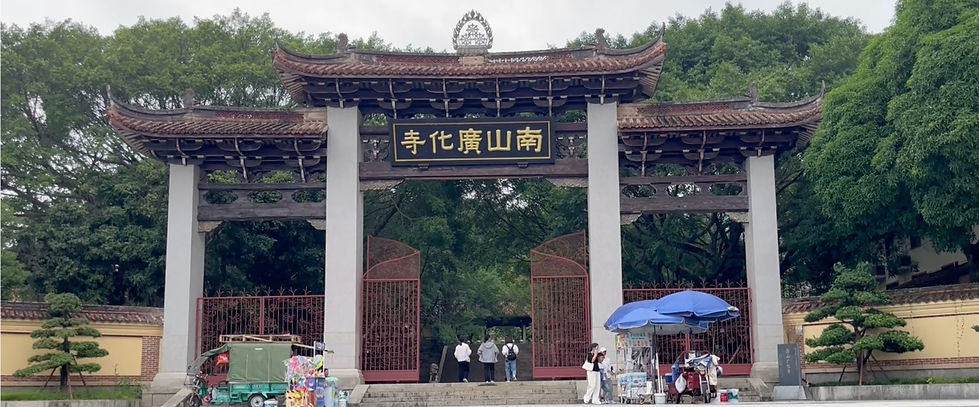
Source: Jason Ong & 林洲
Source: Author & 林洲
Introduction
The inscription at the Nanshan Guanghua Temple in Putian holds two important clues to the founding of Putian and the early history of the people later known as the Hinghwa.
The Hinghwa people have a long and rich history. As modern-day archaeologists have uncovered, our ancestors lived in the southern region for nearly as long as Chinese civilization has existed in the north. This remarkable discovery challenges the popular belief that the Hinghwa people were migrants from Henan Province.
It has also been proven that the ancestors of the Hinghwa had already established a thriving civilization in the region during that time.
As Professor Chen states:
"兴化地区已发现的新石器古文化遗址表明,早在 5500-3500 多年前,先民们已在兴化湾南日岛、埭头后郑、仙游双桥以及莆城东岩山这些地域周围,从事原始农业和渔猎活动,繁衍生息。从出土的文物看,早在三千多年前,兴化先民已在常太山区繁衍生息和创造文明."
“The Neolithic cultural sites discovered in the Hinghwa area show that as early as 5,500 to 3,500 years ago, the ancestors were already engaged in primitive agriculture, fishing, hunting, and settlement and population growth around Nanri Island (南日岛) in Hinghwa Bay, Houzheng in Daitou, Shuangqiao in Xianyou, and Yanshan in the eastern region of Pucheng. From the unearthed relics, it is evident that as early as 3,000 years ago, the ancestors of the Hinghwa people were living and creating a flourishing civilization in the Changtai Mountain region.”
During the Warring States period, there was significant movement of troops and people from the north to the south. The north, populated primarily by the Han people, experienced a southward migration, eventually leading to the integration of Han migrants with the Ou, Yue, and Min peoples of the south.
According to Professor Chen C.Y., “The unique merging of the Huaxia people and the southern peoples, as they continued to move south, eventually gave rise to a new ethnic and cultural identity known as the Putian people.”
(华夏文明和岡越文明的紧密结合, 孕育出独特的莆田文明).
Therefore, it is technically not wrong to say that some of our ancestors came from Henan, because after more than a thousand years of integration, many of our forebears could indeed have originated from the north. However, the key point is that the Hinghwa people were not originally part of the Han Chinese. It was only after a long period of cultural and ethnic blending that we became integrated into the Han identity.
This section will therefore attempt to trace the ancient history of Putian and the Hinghwa people, including their glorious period during the Tang and Song Dynasties.
*

© 2026 Jason Ong. All Rights Reserved. > "Hinghwa Heritage Centre" and "Guardians of Hinghwa Heritage" are proprietary names and initiatives established for the preservation of Hinghwa culture.
No part of this website or its initiatives may be reproduced or used without explicit written permission.