
Another project of the Hinghwa Heritage Centre


Source: Author
When the Song dynasty fell in 1279, the heyday of the Hinghwa people also declined. What followed was a long and bitter winter that lasted nearly 700 years, marked by three devastating massacres.
It was a period that felt as if the wheels of fortune had frozen in a snowstorm -- a dark and unforgiving chapter in their history.
This is their story, as recorded by various sources, including the Putian County Chronicles, which was commissioned during the reign of Emperor Kangxi.
The events that eventually led to the Hinghwa diaspora to Nanyang began with the fall of the Song dynasty, when Mongol forces broke through the Southern Song’s defences.
There are accounts of the valiant resistance put up by the Hinghwa people and their southern counterparts in the fight against the Mongol invaders. Yet, this was a formidable challenge, as the Mongols possessed superior military tactics and overwhelming strength, enabling them to conquer vast territories stretching as far as Europe.
*
Yuan Dynasty
(元朝; 1271AD - 1368AD)
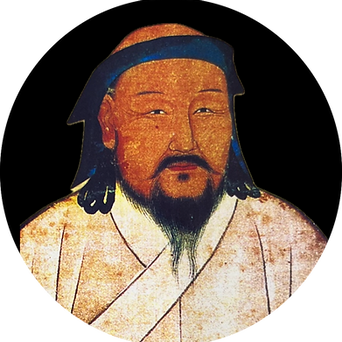
Kublai Khan
Source: Hui Min
In 1235, the Mongols under the command of Kublai Khan (忽必烈), launched an attack on the Southern Song dynasty. Although the Hinghwa Army was small in number, they fought valiantly under the leadership of Chen Wen Long (Zaifu; 宰辅).
This was one of the most brutal battles the Mongols had ever faced. The strong defense of the Hinghwa forces managed to hold out until 1271, when the Mongols finally breached their defenses (Lu, 2019). This led to the first massacre of the people in the Hinghwa region (Zhou, 2008m, p. 12). Prof. Chen concurs with this account of the massacre, but notes the year as 1276.
At this point, the Mongols plundered the land, raped, and killed everyone they could reach. However, the worst was yet to come. Wokutai Khan (窝阔台汗), who was in charge of the Southern region, ordered the rounding up of young women, herding them like cattle into a pen, where they were openly raped in front of the crowd (Weatherford, 2018).
*
Ming Dynasty
(明代; 1368–1644 AD)

Emperor Zhu Yuanzhang & the Forbidden City.
Source: Author & Hui Min
The Ming dynasty began in 1368. During the reign of the third emperor, Yongle (永樂), the administration launched several monumental projects, including the construction of the Temple of Heaven, the Forbidden City, the casting of the Yongle Bell, and the commissioning of a fleet of approximately 300 ocean-going ships. The Temple of Heaven served as a constant reminder to the emperor that his mandate to rule came from Heaven.
The Yongle Bell was created to commemorate the relocation of the capital from Nanjing to Beijing. According to the Beijing Municipal Cultural Heritage Bureau, the bell stands 5.5 meters tall, 3.3 meters wide at its base, and weighs 46 tonnes.
Professor Hua Jue Ming of the Chinese Academy of Sciences notes:
"Out of these four magnificent projects, only the first three remain today. The fleet that once made China the world’s first naval superpower was either burned or destroyed on the orders of succeeding emperors."
This fleet was commissioned for Admiral Cheng Ho (Zheng He) to transport Chinese goods to nations across the Nanyang (Southeast Asia) and beyond. Around 1432, Cheng Ho embarked on his seventh and final voyage. During five of his expeditions, he visited Malacca.
On this last journey, he died before the fleet could return from the Indian Ocean. He is believed to have been buried at sea. The fleet eventually returned to China, but it never sailed again. The new administration, opposed to further maritime expeditions, ordered its destruction.
The dismantling of the world’s first naval superpower created a defensive vacuum, which opened the door to a series of disasters originating from the sea.
First came the rise of Japanese pirates, who took control of the South China Sea, reaching as far as the Philippines. They soon turned their attention to southern China, which they saw as easy prey.
When the Ming authorities cracked down on piracy, disgruntled pirates, supported by merchants, smugglers, and corrupt officials who had lost income due to the crackdown, retaliated. They attacked Putian and the surrounding regions in revenge.
These bandits were collectively known as the Wokou (倭寇). Their raids, marked by looting, burning, and raping, left the region devastated. Many residents fled to nearby mountains and sugarcane plantations to escape the violence.
According to Professor Chen, this period marked the second massacre of Putian in 1562. Around the same time, farther afield in Southeast Asia, the Spanish finally succeeded in colonising the Philippines in 1565 AD, following several failed attempts.
---
After nearly 300 years (1368AD to 1644AD), the weakened Ming dynasty was soon replaced by yet another dynasty, the Manchurians.
*
Qing Dynasty
(情朝; 1644-1912 AD)

Emperor Kangzi
Source: Hui Min & 曾文娇
During the Wokou incident, the Ming dynasty administration constructed a 2-kilometer-long wall to defend against Japanese invaders. This wall was later extended to 37 kilometers during the Qing dynasty to keep out the rebel forces led by Zheng Chenggong (郑成功). As shown on the map, the demarcated area corresponds to the present-day Xiuyu District.
*
Length of Jiewai Wall

Source: Google Maps
Illustration by Author
The extended wall exacerbated the suffering of the Putian people in the south. A native of Putian recorded this period as ‘Out of Bounds’ (界外; Jiewai).
During this time, all water and grain were prohibited from entering the region.
This was one of the worst periods for the affected Putian people, with many starving and being massacred (Ruan, Q. S., 2012). Chen (2014d) concurs that this was the third massacre in Putian history, which occurred in 1648.
*
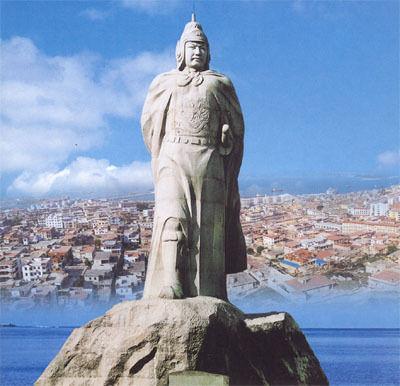
Zheng Cheng Gong (郑成功)
Source: 徐嵘
Video Link

AI-generated illustration of Taiping Rebellion
Source: OpenAI (2025).
The Taiping Rebellion began with significant foreign influence.
The deep hatred for the Empress Dowager Cixi was so overpowering that the people desecrated and emptied her grave some years later.
The continued cruelty of the Qing Court led to the Taiping Rebellion, which was led by Hong Xiuquan, who became a cult figure under the banner of the Taiping Heavenly Kingdom, attracting 2 million followers.
He was believed to have been radicalized by Christian missionaries, and he proclaimed himself to be the brother of Jesus Christ. Millions perished when civil war erupted. Although the Qing forces eventually regained control, they were weakened considerably, which allowed the British to take control of the ports.
This period also coincided with the Opium Wars. It was a time when the Southern Chinese people, followed by the Xinghua, were fleeing their homes and heading toward the Nanyang. Soon, human trafficking boomed. Those who hesitated were tricked or enticed to risk the treacherous sea journey to the unknown.
They were packed into boats, with only enough space to squat or stand. They were then referred to as 'piglets', to be sold overseas by human traffickers. Putian became known as the ‘pigsty’, where traffickers could pick up humans as if they were pigs to be sold at the market (PROCF, 2016a, para 5).
Many of the Chinese aboard these boats, who made their way to their new homeland, were heavily indebted to the traffickers or companies that had financed their journey to Singapore. In a way, they were luckier than others who perished during the sea voyage, where their bodies were given a sea burial. The Qing dynasty finally came to an end after ruling China for 267 years (1644 AD - 1912 AD).
Soon after the fall of the last dynasty, civil war erupted once again. The migration continued until the victorious Communists closed China’s doors to the outside world in 1949. This marked the end of Imperial Chinese history, which spanned over 5000 years.
According to the Putian County Chronicles (莆田县志), recorded by Liao Biqi (廖必琦), the period toward the end of the Ming dynasty and the Qing dynasty was the worst period. People suffered from natural disasters, such as famine caused by droughts and floods that constantly destroyed crops.
In such dire conditions, leaving was not a choice but a necessity, as many made their way to Nanyang in search of a better life.
*
When the Ming dynasty dismantled what was then the world's first naval superpower, it left China’s vast coastline exposed and undefended. This vulnerability later enabled foreign powers to launch attacks and seize territory with impunity, during the Qing dynasty. These events set off a series of catastrophes that ultimately plunged China into one of its darkest periods, which would come to be known as the
Century of Humiliation.
Video Link
Burning and Looting of Summer Palace
Note: These videos are from third party sources. Please view them with discretion.


AI-generated illustration of the Opium War
Source: OpenAI (2025).
AI-generated illustration of the burning of Summer Palace
Source: OpenAI (2025).
With China's defenses weakened, European powers and island nations from across three oceans began staking territorial claims. During this period, in addition to the loss of Macau to Portugal and Hong Kong to the United Kingdom, the nation also faced a devastating rise in widespread opium addiction, contributing to significant social and political decline.
This was the result of the first opium war.
*
To add insult to injury, many of these aggressor nations were tiny, compared to China’s vast size and long history. Yet their encroachments emboldened others, culminating in a national catastrophe: the invasion by forces from eight foreign powers and the burning of the emperor’s residence, the Summer Palace.
China plunged into what became known as the “Century of Humiliation”, a period marked by foreign domination, internal strife, and national decline.
This was the devastating outcome of the Second Opium War,
What followed was a massacre of epic proportions -- an episode so deeply etched in the nation’s collective memory that every Chinese student is required to study and recite it as part of their history education.
Amidst the chaos and immense hardships, the people saw a silver lining that would give rise to the Nanyang Chapter.

On the sidewalk of Beijing, the image of a Qing dynasty man with a ponytail stirred a vivid childhood memory. I once encountered someone like him, perhaps one of the last living remnants of the Qing dynasty, or possibly a descendant of a former Qing official. In the crowd, he stood out like a figure from another time.
I was surprised that he had managed to keep his mandated tradition, the traditional ponytail enforced during Qing rule, considering how, after the dynasty’s fall, many were hunted down and forcibly shorn of this symbol of imperial submission. It was a time when rejecting the traditional order was a public declaration of liberation from Qing tyranny.
Many Chinese migrants who fled during or after the Qing era never forgot the pain and oppression they had endured. For some, like him, the memory lingered visibly, braided into the hair they wore, a quiet, living thread connecting past and present.
*
Qing Dynasty Barber from the sidewalk of Beijing
Source: Author
The fall of the Qing dynasty signaled the end of a long winter, or so it seemed.
Alas, that hope was short-lived. Instead of unity, the collapse of imperial rule gave way to infighting, as various factions scrambled for control and squabbled over the spoils of war. It was only during the Japanese invasion that these rivals were forced to set aside their differences and unite, albeit temporarily, in defense of the nation.
When the war against Japan ended, the uneasy alliance quickly unraveled. The power struggle resumed, this time between the Communist Party and the Kuomintang.
It was during this era of upheaval and shifting loyalties that Putian produced some of its finest military leaders when courage, conviction, and sacrifice defined one’s legacy.
Among them were General Zhang Yunyi and General Liao Hua.
A Revolutionary Leader

General Liao Hua (1898–1969)
Born in August 1898 in Putian County, Fujian Province, Liao Hua was among the earliest members to join the Communist Party of China, doing so in 1926. That same year, he founded the Party's first organisation in Putian, a historic milestone that marked the beginning of a revolutionary chapter in the region.
A committed patriot and military leader, Liao Hua later became a general of the New Fourth Army, where he fought alongside General Zhang Yunyi, another distinguished son of Putian. Like many revolutionaries of his time, Liao Hua was known by several names, including Wang Xiaolin, Chen Jizhou, and Chen Guozhu.
While name changes were common in that era, sometimes influenced by beliefs in Feng Shui, and other times adopted for security reasons during the turbulent years of war, the precise reasons for his multiple aliases remain unclear. One theory suggests they were used to evade arrest and persecution by enemy forces.
Despite his efforts, Liao Hua was eventually captured, possibly tortured, and imprisoned. Yet, upon his release, he was welcomed by men dispatched by none other than Zhou Enlai, who would later become the first Premier of the People’s Republic of China. Liao Hua's unwavering loyalty and contributions did not go unrecognised. In the years that followed, he rose to hold senior positions in the newly established government, including serving as Secretary to the Putian Special District Committee of the Communist Party of China, as well as director of several ministries.
His legacy remains a powerful reminder of courage, conviction, and the enduring spirit of Putian.
Excerpts from: Baidu: https://baike.baidu.com/item/%E5%BB%96%E5%8D%8E/59937
---
During the Chinese Civil War, the lines between friend and foe were often blurred.
In a nation torn by conflict, many found themselves caught between warring factions, all of them fellow Chinese. It was a time when loyalties were tested, identities concealed, and trust became a rare commodity. The greatest tragedy was not just the violence, but the pain of a nation divided against itself.
*
The wars and unending sufferings during and after the fall of the Qing dynasty set the stage for a wave of mass migration, giving rise to what became known as the Nanyang Chapter.
*

© 2026 Jason Ong. All Rights Reserved. > "Hinghwa Heritage Centre" and "Guardians of Hinghwa Heritage" are proprietary names and initiatives established for the preservation of Hinghwa culture.
No part of this website or its initiatives may be reproduced or used without explicit written permission.